
Commercial Solar Installation for Manufacturing Industries
Manufacturing industries rely on a steady supply of electricity to operate machinery, production lines and other essential equipment. Rising power costs can increase operating expenses and affect overall profitability. Commercial solar installation for manufacturing industries helps businesses generate electricity from sunlight, reduce dependence on grid power and manage long-term energy costs. With suitable rooftop or ground-mounted solar systems, manufacturers can improve energy efficiency while moving towards more sustainable industrial operations.
Commercial Solar Solutions for Manufacturing Industries
Industrial power in UP is expensive in ways that don’t show up in the per-unit rate. Units on LMV-6 and HV-2 tariffs pay an energy charge, a fixed charge and a demand charge on contract load. Add in yearly tariff revisions and your power bill becomes one of the few costs you can’t negotiate.
Solar changes that. Every unit your roof produces is a unit you don’t buy from PVVNL or NPCL. For a factory running day shifts, most of that power gets used on-site the moment it’s generated, which is where the real savings are.
Our commercial solar installation work covers the full EPC scope: load study, structural check, design, supply, installation, net metering and after-sales service. We’ve built plants for units in Sector 63 and Phase 2 in Noida, Ecotech and Surajpur in Greater Noida, and the Sahibabad and Meerut Road industrial areas in Ghaziabad.
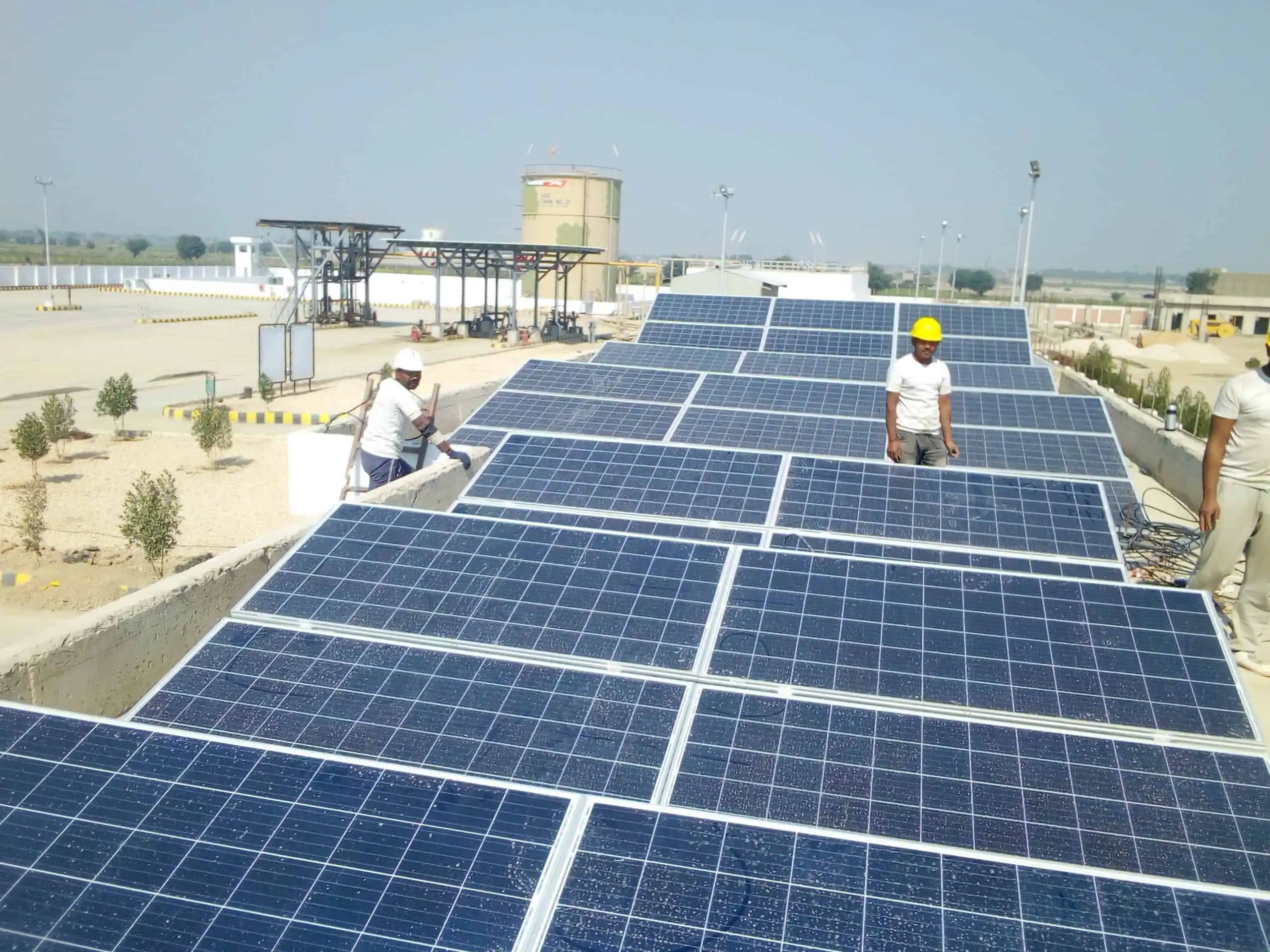
Solar Systems for Manufacturing Facilities
Rooftop Solar Systems
This is the right fit for most manufacturing units. Your shed roof is already there, and it’s usually doing nothing but taking the heat.
We install on metal sheet roofs, RCC roofs and pre-engineered buildings. On sheet roofs, we use non-penetrating clamps so there are no drilled holes and no monsoon leaks. Structures are rated for wind speeds up to 170 km/h. Most rooftop plants are on-grid solar systems that feed surplus power back to the grid through net metering.
Rough space guide: 1 kW needs about 80 to 100 sq ft of shadow-free roof.
Ground-Mounted Solar Systems
Got open land inside the premises but a weak or crowded roof? A ground-mounted plant works well here. It’s easier to clean, easier to maintain, and the panel tilt can be set for maximum yield. We see this most in larger Greater Noida plots and the outer industrial belts of Ghaziabad.
Hybrid Solar Systems with Battery Storage
Some operations can’t afford to stop. Pharma units, cold storage, food processing and lines with sensitive controls all fall in this group. A hybrid solar system combines panels with battery storage, so critical loads keep running during grid cuts and your DG set runs less often.
Not sure which one suits you? This breakdown of on-grid vs off-grid vs hybrid solar walks through the trade-offs.
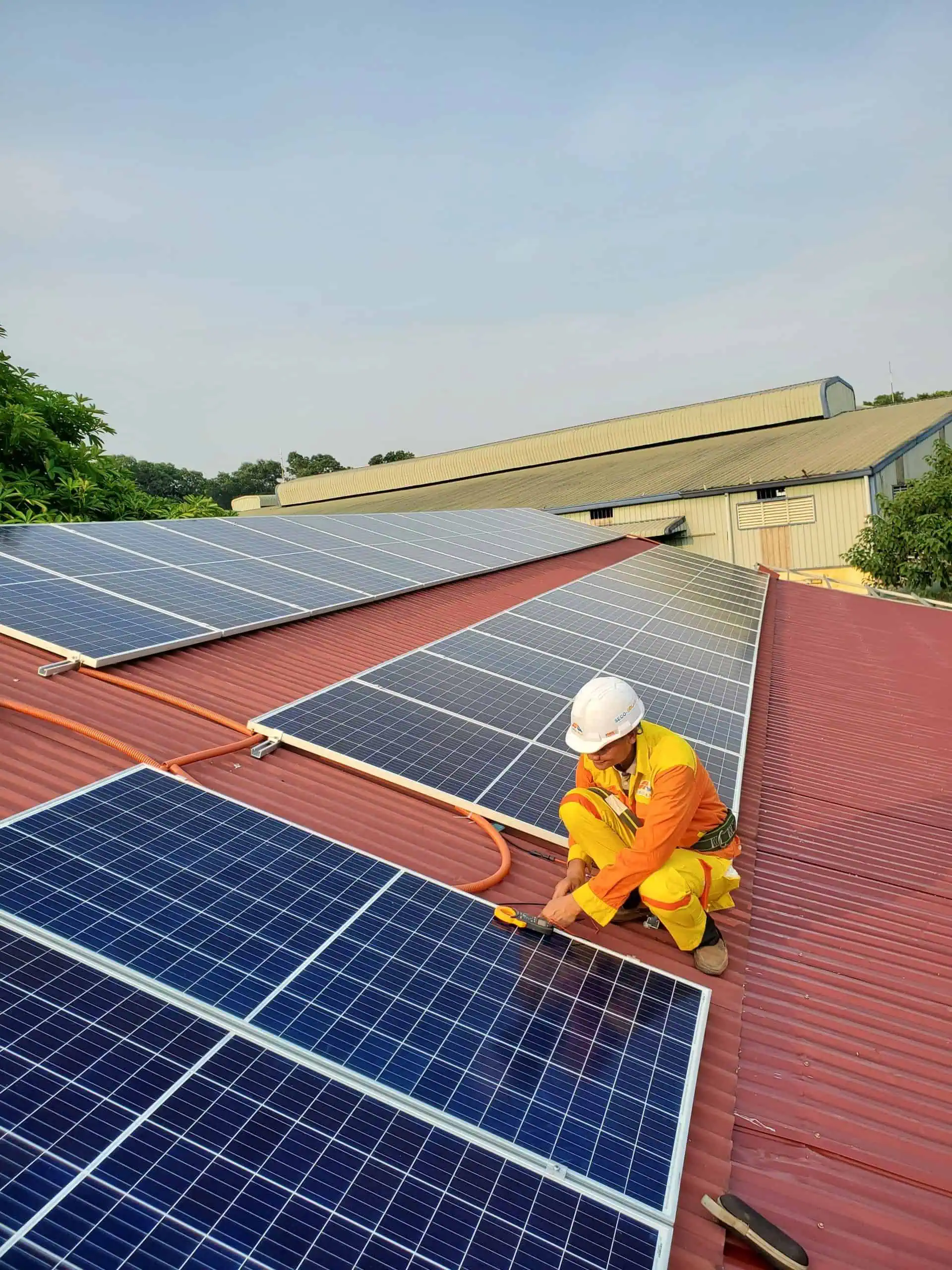
- Why Install Solar for Manufacturing Industries?
Reduce Electricity Costs
A well-sized plant can cut a factory’s grid purchase by 40 to 70%, depending on roof space and load. As a rough number, every 100 kW of solar generates around 1.5 lakh units a year. At industrial tariffs, that’s ₹12 to ₹14 lakh saved annually. Most of our factory projects pay for themselves in 2.5 to 4 years, and the panels keep producing for 25.
There’s a tax angle too. Eligible businesses can claim 40% accelerated depreciation on solar assets, which lowers the effective cost further.
Make Better Use of Available Roof Space
Factory roofs are big, flat and mostly empty. Putting panels on them turns dead space into a power plant. There’s a side benefit people rarely mention: panels shade the sheet, which can bring down temperatures on the shop floor below.
Reduce Dependence on Grid Electricity
Every kW of solar lowers what you draw from the grid during peak production hours. Pair it with batteries and you also cut diesel use during outages, which means lower fuel bills and fewer generator maintenance headaches.
Support Long-Term Energy Planning
Grid tariffs go up almost every year. Solar power doesn’t. Once the plant is built, your cost per unit is locked for two decades. That makes budgeting easier and gives you a solid answer when export buyers or large OEM clients ask about your carbon footprint and ESG compliance.
- Our Commercial Solar Installation Process
Site survey and load study
Our engineer checks your roof, shading, electrical panel and 12 months of bills. We look at shift timings, not just total units.
Site Survey
You get a system layout, generation estimate, cost, payback period and savings projection in writing. No vague “up to” numbers.
Structural check
We confirm your roof can take the load before anything goes up. Older sheds sometimes need minor reinforcement, and we’ll tell you upfront.
Installation
A dedicated project manager runs the work in phases around your production schedule, so your lines don’t stop.
Approvals and net metering
We handle the paperwork with PVVNL (Noida and Ghaziabad) or NPCL (Greater Noida) through to meter installation.
Commissioning and monitoring
You get remote monitoring from day one, plus scheduled cleaning and maintenance support.
Most commercial installations take 1 to 3 weeks on site. DISCOM approvals add a few weeks depending on the department’s processing time.
Solar Solutions for Different Manufacturing Facilities
| Facility Type | Typical Load Pattern | What Usually Works |
|---|---|---|
| Auto Components and Engineering | Heavy daytime machinery, compressors, CNC | Large rooftop on-grid plant |
| Garments, Hosiery and Textiles | Sewing lines, pressing, lighting on day shifts | Rooftop on-grid, high self-consumption |
| Electronics and Assembly | Steady daytime load, sensitive equipment | On-grid with clean power backup for critical lines |
| Plastics, Packaging and Moulding | High-power moulding machines, long shifts | Maximum roof coverage plus ground mount if land allows |
| Pharma and Food Processing | 24x7 cooling and process loads | Hybrid solar with battery storage |
| Printing and Paper Units | Day-heavy with peak spikes | Rooftop on-grid sized to base load |
Running a unit in Ghaziabad specifically? See our solar panel installation in Ghaziabad page for local details.
Factors That Affect Commercial Solar Installation Cost
For reference, current pricing in our service area looks like this (before GST and tax benefits):
| System Size | Approx. Roof Area | Indicative Cost (ex-GST) | Typical Fit |
|---|---|---|---|
| 50 kW | 4,000 to 5,000 sq ft | ₹25 to ₹28 lakh | Small factory, workshop |
| 100 kW | 8,000 to 10,000 sq ft | ₹45 to ₹50 lakh | Mid-sized manufacturing unit |
| 250 kW | 20,000 to 25,000 sq ft | ₹1.05 to ₹1.25 crore | Large plant, warehouse |
| 500 kW | 40,000 to 50,000 sq ft | ₹2.1 to ₹2.5 crore | Heavy-consumption unit |
What moves the final price:
- System size: Larger plants cost less per kW.
- Panel choice: Commercial projects can currently use non-DCR panels, which helps on cost. Read our update on non-DCR solar panels for commercial use.
- Roof type: Metal sheet, RCC and ground mounts need different structures.
- Battery storage: Hybrid systems cost more upfront but protect critical loads.
- Inverter setup: String vs central inverters, based on layout and plant size.
- Site conditions: Cable run length, shading and roof height all affect labour and material.
Want a quick estimate first? Try our solar calculator, then book a survey for exact numbers.
- Why Choose Solar Oorja for Manufacturing Solar Projects
Local team
Based in the region and familiar with PVVNL and NPCL processes, so approvals don’t stall.
Tier 1 equipment only
BIS-certified, ALMM-listed panels from brands like Tata Power Solar, Adani Solar and Waaree. 25-year panel warranty, 10-year inverter warranty.
Zero-downtime installation
Work is planned around your shifts.
Honest sizing
We size to your actual load and roof. Oversized plants look good on paper and waste money in practice.
Single point of contact
One project manager from survey to commissioning.
After-sales that shows up
Local service means faster response when something needs attention.
Learn more about Solar Oorja and the projects we’ve delivered.
Ready to see what your roof can save? Talk to our commercial solar team for a free site survey and a written ROI proposal.
Frequently Asked Question
How much does solar installation cost for a factory in Noida?
A 100 kW system costs roughly ₹45 to ₹50 lakh before GST. Final cost depends on roof type, panel brand, and whether you add battery storage. After accelerated depreciation, the effective cost drops noticeably.
What size solar system does my manufacturing unit need?
It depends on your monthly consumption, shift hours and usable roof space. As a starting point, 1 kW needs about 80 to 100 sq ft and generates around 1,500 units a year.
What is the payback period for industrial solar in Greater Noida?
Most factory projects pay back in 2.5 to 4 years. Units with high daytime consumption and higher tariffs recover the cost faster.
Can solar panels be installed on a metal sheet factory roof?
Yes. We use non-penetrating clamps on sheet roofs, so there’s no drilling and no leakage risk. We also check the roof’s structural capacity before installation.
Will installation disrupt production?
No. We plan the work in phases around your shift schedule. Final electrical connection is usually done during a planned shutdown or off-shift hours.
Do you handle net metering approvals in Ghaziabad and Noida?
Yes. We manage the full application and coordination with PVVNL for Noida and Ghaziabad, and NPCL for Greater Noida.
Can I get tax benefits on commercial solar?
Eligible businesses can claim 40% accelerated depreciation on solar assets under the Income Tax Act. Check the specifics with your CA for your company’s tax position.