
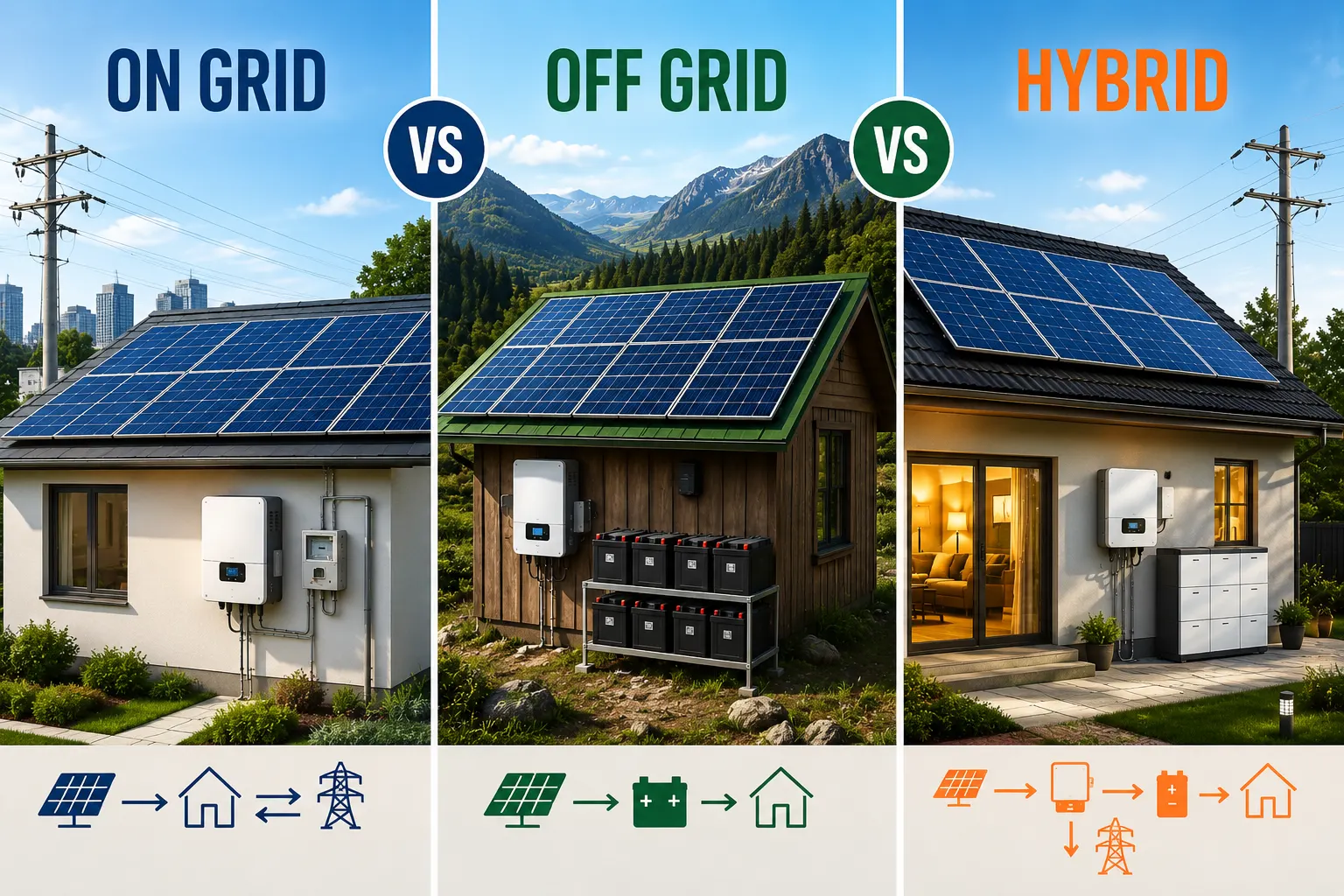
You’ve decided to install solar, checked your roof, and started comparing quotes. Then comes the confusing part: on-grid, off-grid, or hybrid—which one should you actually choose?
If you’re a homeowner in Noida, Greater Noida, Delhi NCR, or elsewhere in India, the answer isn’t simply “the system with the most features.” The right choice depends on your electricity usage, how often your power goes out, whether you need battery backup, your roof space, and how you want to manage your electricity bill.
Understanding on-grid vs off-grid solar before you buy can save you from spending more than necessary—or discovering after installation that your system doesn’t provide the backup you expected.
So, let’s make the choice simple.
First, What Do On-Grid, Off-Grid, and Hybrid Solar Mean?
All three systems use solar panels to generate electricity. The major difference is what happens to that electricity after it is generated and whether a battery is included.
What Is an On-Grid Solar System?
An on-grid solar system, also called a grid-tied system, is connected to your home and the local electricity grid.
During the day, your solar panels generate electricity. Your home uses the power it needs first. If your panels produce more electricity than your home is consuming, the surplus can be exported to the grid through an approved metering arrangement such as net metering, subject to applicable state and DISCOM rules. When solar generation is insufficient, you draw electricity from the grid.
The biggest advantage: you generally don’t need a battery.
Pros
- Lower upfront cost compared with battery-based systems
- Can reduce electricity purchases from the grid
- No battery replacement to plan for
- Relatively simple system design
- Can use net-metering arrangements where permitted
Limitation: A standard on-grid system normally shuts down when the grid goes out. This is an important safety feature, so solar panels alone should not be treated as power backup.
Best for: Homes in areas with reasonably reliable grid electricity where the main goal is reducing electricity bills.
For many urban homes in Noida and Greater Noida, this can be the most economical starting point.
What Is an Off-Grid Solar System?
An off-grid solar system operates independently of the electricity grid.
Solar panels generate electricity, while batteries store energy for use when the sun isn’t producing enough power. The system therefore needs enough generation and storage to meet your household’s requirements.
MNRE describes off-grid solar applications as particularly relevant where grid electricity is unavailable or unreliable.
Pros
- Can operate without a grid connection
- Provides battery-based backup
- Useful in remote locations
- Greater independence from the utility grid
Limitations
- Requires batteries
- Higher system complexity
- Battery capacity has to be carefully sized
- Higher upfront investment than a basic grid-tied system
- Battery maintenance and eventual replacement need to be considered
Best for: Properties where grid electricity is unavailable, highly unreliable, or where energy independence is more important than minimizing the initial investment.
What Is a Hybrid Solar System?
A hybrid solar system combines grid connectivity with battery storage.
Think of it as a system designed for two priorities: lower electricity consumption from the grid and backup during outages.
Solar power can serve your home during the day, surplus energy can be stored in the battery depending on system configuration, and the grid can supplement your electricity needs. When the grid fails, compatible loads can continue operating from the battery.
Pros
- Battery backup during power cuts
- Can reduce dependence on grid electricity
- More flexible than a basic on-grid setup
- Useful where outages are frequent but grid connectivity is available
Limitations
- More expensive than a standard on-grid system
- Batteries add maintenance and replacement considerations
- Correct battery sizing is essential
Best for: Homeowners who want solar savings but don’t want to lose access to essential appliances during power cuts.
On-Grid vs Off-Grid vs Hybrid Solar: Key Differences
| Feature | On-Grid | Off-Grid | Hybrid |
| Grid connection | Yes | No | Yes |
| Battery | Usually no | Yes | Yes |
| Backup during power cuts | No, with a standard grid-tied system | Yes | Yes, for supported loads |
| Net metering | May be available, subject to local rules | No | Depends on configuration and local rules |
| Initial cost | Lowest of the three | Usually highest | Usually higher than on-grid |
| Battery maintenance | Not normally required | Required | Required |
| Best suited for | Reliable grid + bill reduction | No/poor grid | Grid connection + backup requirement |
The important point is that there is no universally “best” solar system. The best solar system for a home depends on what you need the system to do.
Which Solar System Is Best for Your Home?
Instead of choosing based on the latest inverter or biggest battery, start with your actual situation.
You have reliable grid electricity
An on-grid solar system is usually worth considering first.
If power cuts are rare and your main objective is to reduce your electricity bill, paying extra for a large battery may not make financial sense.
You experience frequent power cuts
A hybrid solar system may be a better fit.
You can use solar to reduce grid consumption while keeping battery backup for important appliances such as lights, fans, Wi-Fi, refrigerators, or selected circuits.
The battery should be sized around the loads you actually want to keep running—not necessarily your entire house.
Your property has no reliable grid connection
An off-grid system may make more sense.
However, don’t size it only around your daytime electricity consumption. You also need to consider nighttime usage, cloudy periods, battery storage, and the amount of backup you require.
Your main goal is lowering electricity bills
An on-grid system is often the first option to evaluate, particularly where grid electricity is available and an appropriate net-metering arrangement is permitted.
You need dependable backup
Look at hybrid or off-grid solar rather than assuming an on-grid system will keep your appliances running during an outage.
What Should You Consider Before Choosing a Solar System?
Before accepting an installation quote, look at these seven factors.
1. Your electricity consumption
Check your recent electricity bills instead of guessing your system size.
A home using 200 units a month and a home using 800 units a month shouldn’t automatically receive the same recommendation.
2. Frequency and duration of power cuts
A short outage once a month creates a very different battery requirement from several hours of outages every week.
3. Available roof space
Your installer should check usable, shadow-free roof area, orientation, structural conditions, and possible shading from nearby buildings or trees.
4. Your budget
Don’t compare only the panel price. Consider the inverter, mounting structure, wiring, protection equipment, installation, approvals, batteries if required, and long-term maintenance.
5. Battery requirement
Ask yourself a simple question:
“What exactly do I need to keep running when the grid goes down?”
If the answer is only lights, fans and internet equipment, your battery requirement may be very different from someone who wants to operate multiple ACs and heavy appliances.
6. Future electricity needs
Your electricity consumption may change if you plan to buy an electric vehicle, install more ACs, expand your home, or add other high-consumption appliances.
7. Net metering, DISCOM rules and incentives
Solar regulations aren’t identical across India. Before installation, check the current rules applicable to your electricity connection and DISCOM.
For Uttar Pradesh consumers, UPPCL provides online services for Net Metering/Net Feed-in, so the applicable process should be confirmed before finalizing the system.
For eligible residential consumers, the PM Surya Ghar scheme provides Central Financial Assistance. Current scheme guidelines specify ₹30,000/kW for the first 2 kW and ₹18,000 for the next 1 kW, giving a maximum central CFA of ₹78,000 for an individual residential installation under that structure. States may provide additional support subject to their own rules.
Because policies and DISCOM procedures can change, verify the applicable subsidy and metering rules when you apply rather than relying on an old quote or blog post.
On-Grid, Off-Grid, or Hybrid: Which One Should You Choose?
Here’s the simplest decision framework:
Choose on-grid if:
Your grid supply is reliable and your priority is reducing electricity bills without adding battery costs.
Choose off-grid if:
You don’t have dependable grid access and need the solar system to operate independently.
Choose hybrid if:
You have grid electricity but also want battery backup during power cuts.
For most homeowners, the right decision starts with electricity consumption + outage pattern + backup requirement, not simply the size of the roof.
If you’re unsure, get the system designed around your actual bills and site conditions rather than buying a standard package.
Choosing the Right Solar System Starts With Your Home
The smartest solar purchase isn’t necessarily the biggest system or the one with the most features.
It’s the one that matches how much electricity you use, how much roof space you have, how reliable your grid connection is, and whether you actually need battery backup.
If you’re considering a residential solar system in Noida or Greater Noida, start by reviewing your recent electricity bills and identifying your essential backup loads. A proper site assessment can then determine the appropriate system size, equipment configuration, and expected generation.
You can explore Solar Oorja’s residential solar installation service for more information, or review the company’s solar subsidy guide for Noida to understand the current subsidy process.
The goal isn’t simply to install solar panels. It’s to install the right solar system for the way your home actually uses electricity.
If you’re still deciding between on-grid, off-grid, and hybrid, share your latest electricity bill and roof details with a solar professional. A customized assessment can tell you which configuration makes sense before you commit your money.
Frequently Asked Questions
1. Which is better, on-grid or off-grid solar?
For a home with reliable grid electricity where the main objective is reducing electricity costs, on-grid solar is often the simpler option. Off-grid makes more sense when grid availability is poor or independence from the grid is essential.
2. Can on-grid solar work during a power cut?
A standard grid-tied solar system generally shuts down when the grid fails. This prevents electricity from being fed into a de-energized grid and protects utility workers. If backup during outages is important, consider a suitable battery-based or hybrid configuration.
3. Does an off-grid solar system need batteries?
Yes. Since an off-grid system cannot rely on the electricity grid when solar generation is unavailable, battery storage is normally a core part of the system.
4. Is hybrid solar worth it for a home?
It can be worthwhile if you want both solar generation and battery backup. Whether the additional investment makes sense depends on how frequently you experience outages and which appliances you need to run during them.
5. Can I switch from on-grid to hybrid solar later?
Sometimes, but it depends on the inverter, system architecture, electrical design, battery compatibility, and local requirements. If battery backup may become important later, discuss future expansion with your installer before choosing the initial equipment.