
Off-Grid Solar System Installation in Noida, Greater Noida & Ghaziabad
Power your property without relying on the electricity grid. Solar Oorja provides off-grid solar system installation in Noida, delivering reliable, battery-backed solar solutions for homes, farmhouses, commercial sites, and remote locations. From system design and battery sizing to installation and ongoing support, we handle everything to ensure uninterrupted, independent power.
What is an off-grid solar system?
An off-grid solar system is a standalone solar power setup that works completely independent of the electricity grid. It generates power from solar panels during the day, stores the surplus in a battery bank, and runs your home or business off that stored energy whenever the sun is not producing, whether that is at night, during a cloudy spell, or during a grid blackout that would leave everyone else in the dark.
Because there is no grid to fall back on, an off-grid solar power system has to be designed for full autonomy. Autonomy simply means the number of days the system can keep your property running on stored battery power alone when sunlight is poor. On a heavily overcast day, panel output can drop to as little as 12 to 15 percent of a clear-sky day, which is nowhere near enough to run a home.
A well-sized off-grid system handles this by banking extra energy on the previous sunny day so your home keeps running on stored power when the weather turns. One day of autonomy covers one low-solar day; two days covers two cloudy days back to back.
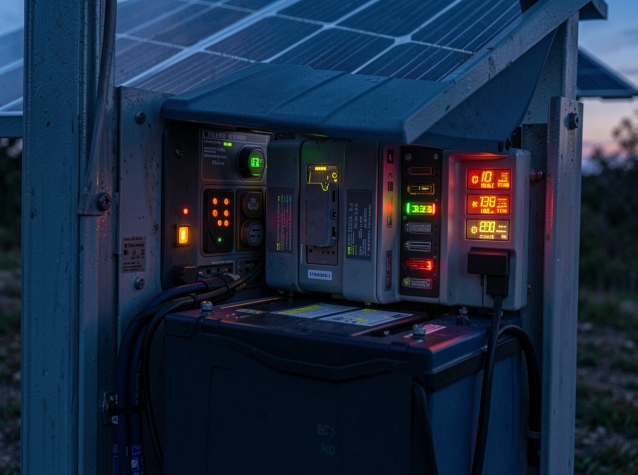
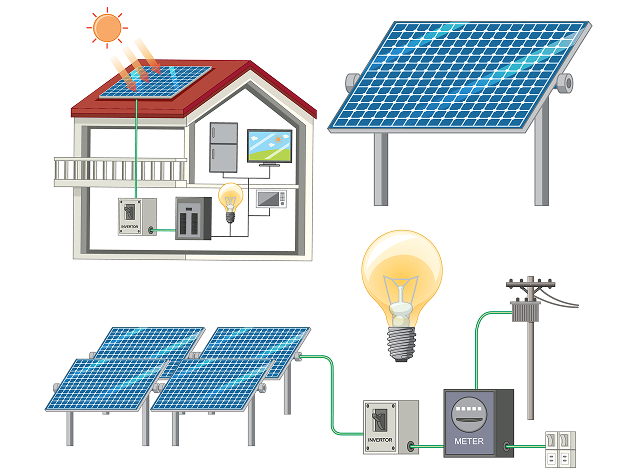
How Off Grid Solar Power Systems Work?
An off grid solar power system runs as a closed loop on your property. Here is the actual energy flow, step by step
- Solar panels generate DC electricity from sunlight.
- That power flows into a solar charge controller, a smart device that regulates voltage and current to charge the battery bank safely.
- Power first runs whatever loads are active in your home or business, such as lights, fans, AC, and appliances.
- Any surplus solar generation goes into charging the batteries.
- Once the batteries hit full charge, the charge controller throttles solar input to prevent overcharging.
- At night or during cloudy weather, your loads draw from the battery bank through an off-grid inverter, which converts the battery's DC output into the AC electricity your appliances actually use.
- With generator backup, if the batteries fall critically low after several cloudy days, an automatic transfer switch fires up a diesel or LPG generator that either runs loads directly or recharges the batteries, then shuts off automatically once they recover.
Benefits of Off-Grid Solar Power Systems
Using an off-grid solar system comprises many benefits such as.
Complete Energy Independence
With an off-grid solar power system, you generate and use your own electricity without depending on NPCL, UPPCL, or any DISCOM. Surplus daytime energy is banked in your battery bank and drawn down whenever you need it, even well after sunset. There is no monthly bill creeping upward with every tariff revision, and no being at the mercy of a utility that raises rates on its own schedule.
Uninterrupted Power Supply Through Every Outage
When the grid goes down, an off-grid system simply does not notice. Your stored battery power keeps lights, fans, the fridge, the Wi-Fi, and any essential equipment running smoothly while the rest of the street sits in the dark. This is exactly why off-grid is the natural fit for areas with unstable or unreliable supply, where two or three hours of electricity a day is the norm rather than the exception.
Ideal for Remote and Off-Grid Locations
These systems are built for places the grid does not reach or reaches badly. Farmhouses on the city outskirts, rural homes, hill-station cottages, construction sites, agricultural pump sets, and remote offices all run dependably on off-grid solar. Where extending a grid line would cost several lakh and take months of approvals, a standalone solar system delivers reliable, clean power from day one, with no transmission infrastructure required.
Off-Grid Solar System with Generator Backup for Total Reliability
For properties that cannot tolerate any downtime, a generator backup turns a good system into a bulletproof one. During an extended cloudy stretch or an unusually heavy load event, an automatic transfer switch starts a diesel or LPG generator, which either runs your loads directly or recharges the batteries, then shuts off on its own once levels recover. You get the savings of solar for 90 percent of the year and a guaranteed fallback for the rare days solar alone cannot cover. This is the single highest-value add-on for medical, cold-storage, telecom, or critical agricultural setups.
Long-Term Cost Savings That Compound
An off-grid system wipes out your monthly electricity bill and shields you from every future tariff hike. The upfront investment is higher, mostly because of the battery, but once you cross the payback period the energy is effectively free for years. With a LiFePO4 battery lasting 10 to 15 years and panels warranted for 25, the lifetime economics work strongly in your favour. Over a 25-year horizon a well-designed lithium system often costs less than running a comparable lead-acid setup, and far less than decades of rising grid bills.
Clean, Silent, Zero-Emission Power
Every unit you generate from sunlight is a unit you are not pulling from a diesel generator or a coal-heavy grid. Off-grid solar runs silently, produces no fumes, and needs no fuel deliveries, which matters most precisely in the remote and residential settings where these systems are installed.
Off Grid Solar System Installation Cost in Noida, Greater Noida & Ghaziabad
Off-grid economics are dominated by battery cost. Solar panels and inverters have fallen dramatically in price over the last decade, but high-capacity batteries remain the single largest line item, accounting for well over half of a lithium-based system. Here is a transparent breakdown for a 5 kW off-grid solar system with a 15 kWh LiFePO4 battery.
| Component | Cost (₹) | % of Total System Cost |
|---|---|---|
| Solar Panels (5 kW Tier-1) | ₹1.5 – ₹1.75 Lakh | 18% – 22% |
| LiFePO4 Battery Bank (15 kWh) | ₹4.5 – ₹6 Lakh | 55% – 65% |
| Off-Grid Inverter (5 kVA Pure Sine) | ₹60,000 – ₹1 Lakh | 8% – 12% |
| Solar Charge Controller (MPPT) | ₹25,000 – ₹50,000 | 3% – 5% |
| Mounting Structure, Cables, Safety Equipment & Installation | ₹60,000 – ₹1 Lakh | 7% – 10% |
| Total System Cost | ₹7.5 – ₹10.25 Lakh | 100% |
Adding a 7.5 kVA diesel generator with an automatic transfer switch adds another Rs 1.5 to 2 lakh. A comparable lead-acid system costs less upfront (around Rs 4 to 5.5 lakh) but, with battery replacement every five years at Rs 1.5 to 2 lakh per cycle, works out to Rs 11 to 15 lakh over 25 years. The lithium system actually costs less over its lifetime despite the higher day-one price. You can also use our solar calculator to get a quick size and cost estimate for your property.
Indicative cost by system size (LiFePO4-based)
| System Size | Daily Output | Battery Capacity | Total Cost |
|---|---|---|---|
| 1 kW Off-Grid Solar System | 4–5 units/day | 4–5 kWh | ₹2–3 Lakh |
| 3 kW Off-Grid Solar System | 12–15 units/day | 10–12 kWh | ₹4.5–6.5 Lakh |
| 5 kW Off-Grid Solar System | 20–25 units/day | 15–20 kWh | ₹7.5–10.5 Lakh |
| 7 kW Off-Grid Solar System | 28–35 units/day | 20–25 kWh | ₹10–13 Lakh |
| 10 kW Off-Grid Solar System | 40–50 units/day | 25–35 kWh | ₹13–18 Lakh |
Off-Grid Power Systems for Homes & Businesses
Off-grid solar is not just a residential solution. The same core setup, panels, battery bank, inverter, and optional generator, scales from a small home to a full industrial site. What changes is the sizing, the load profile, and the reliability engineering behind it.
Off-Grid Power Systems for Homes
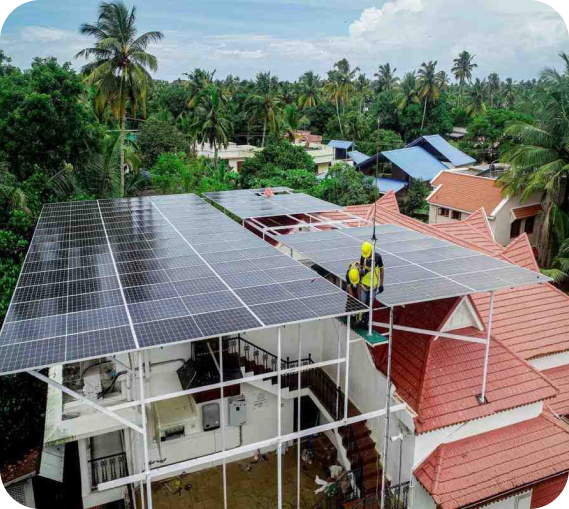
Off grid power systems for homes hit by frequent power cuts or unstable grid supply, an off-grid solar power system delivers electricity that simply does not flicker when the grid does. Solar energy banked in the battery during the day keeps lights, fans, the fridge, and daily appliances running through the night and through outages.
These systems are the natural fit for rural homes, farmhouses, weekend properties, and any home located too far from the main grid for a reliable connection. The system is sized around your actual daily load and the number of cloudy days you want covered, so you are never left guessing whether the power will hold.
Commercial & Industrial Off-Grid Solutions
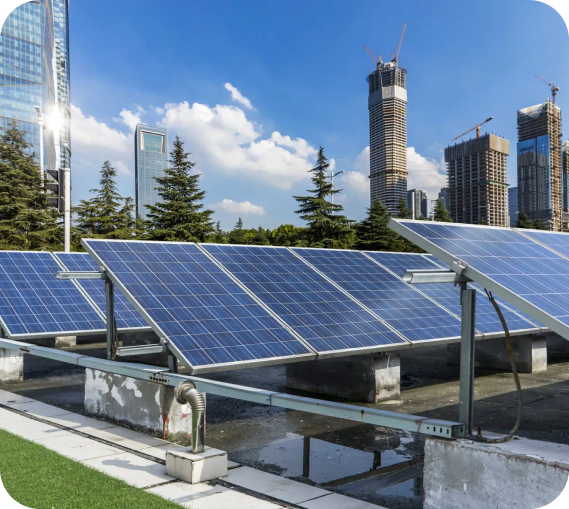
Commercial and industrial off-grid systems are built for the heavier, more demanding loads that businesses run, and for the reality that downtime in a business costs money. We install off-grid solar for warehouses, telecom towers, construction sites, cold storage units, and remote commercial facilities where grid power is either absent or too unreliable to depend on.
Beyond keeping operations running, these systems sharply cut the dependence on diesel generators that so many remote businesses lean on, replacing expensive, noisy, fuel-hungry DG running hours with clean stored solar. The result is a continuous, predictable, and far more cost-effective power supply, with a diesel or LPG generator retained only as an automatic backup for the rare days solar and battery alone cannot cover.
Components That Make the Best Off-Grid Solar System Installation
Off-grid is unforgiving of component compromises. A weak battery, an undersized inverter, or a poorly matched charge controller can leave your property dark exactly when you need power most. Here is what goes into a system built to last, and why each piece matters.
Solar Panels
We install Tata Power Solar and Adani Solar mono PERC panels for off-grid systems. They offer the highest energy density, the best low-light performance, and a 25-year linear performance warranty. Panel quality matters even more in off-grid than in on-grid, because every wasted unit of generation translates straight into a battery shortfall the following night.
Solar Inverter (Off Grid)
The single most important decision in any off-grid solar system is the battery chemistry. In an off-grid build the battery is the largest line item by far, so getting this right is what protects your investment. The battery in an off-grid system is typically 3 to 4 times larger than the battery in a hybrid system of the same inverter size, simply because there is no grid to lean on.
Off Grid Inverter
Off-grid inverters are not the same as grid-tied ones. They must produce clean pure sine wave AC for sensitive electronics, handle peak surge loads such as motor and AC compressor start-up, integrate with battery management, and optionally manage generator transfer. We install Tier-1 brands such as Luminous, Microtek high-end models, Su-Kam, Schneider Conext, and Victron Energy, sized at roughly 1.5 to 2 times your peak load.
Solar Charge Controller
MPPT (Maximum Power Point Tracking) charge controllers pull 20 to 30 percent more energy out of your panels than older PWM units. For everything except the smallest 100 to 300 W setups, MPPT is the standard we use.
Generator Backup (Optional)
A generator backup provides additional electricity during periods of extended low solar generation. It automatically or manually supports the system when battery levels become too low. This adds an extra layer of reliability for continuous power availability in all conditions.
Off-Grid vs On-Grid vs Hybrid: When Off-Grid Is the Right Choice
Most people researching off-grid solar are actually better served by on-grid or hybrid. We are not trying to talk you out of off-grid; we are being straight about where each system genuinely shines. There is no better or worse system here, only the one that fits your situation.
Here is the comparison between an Off-grid, On-Grid and Hybrid solar panel:
| Factor | Off-Grid Solar System | On-Grid Solar System | Hybrid Solar System |
|---|---|---|---|
| Grid Connection Required | No | Yes | Yes |
| Works During Grid Outage | Yes | No | Yes |
| Battery Storage | Required | None | Required |
| PM Surya Ghar Subsidy | No | Eligible | No |
| Net Metering Benefit | None | Full | Partial |
| Ongoing Maintenance | Highest | Lowest | Medium |
You can compare all three system types side by side on our solar solutions page.
- Our Off Grid Solar System Installation Process
Most people do not realise that off-grid installers do far more than physically mount panels. Here is how we run a project from first call to long-term support.
Detailed energy audit
We list every appliance, its wattage, daily usage hours, simultaneous-on probability, and seasonal variation, because undersized systems leave you dark and oversized ones waste money.
Site survey, on-site or remote
For local Noida, Greater Noida, and Ghaziabad sites our engineer visits in person. For distant properties we use satellite imagery, your photos and videos, and structured questionnaires to assess orientation, shading, and structural capacity.
System design
We size the solar array, battery bank, and inverter together, with generator backup recommended wherever any power loss is critical.
Custom proposal
You receive a full bill of materials with brands and warranties, generation projections, a battery cycling and replacement estimate, total cost, an optional generator quote, and a timeline.
Logistics and procurement
Off-grid sites are often remote, and lithium batteries carry shipping restrictions, so we plan deliveries carefully, sometimes in multiple shipments for larger projects.
Installation, typically 3 to 7 days
This runs longer than an equivalent on-grid job because battery banks need careful busbar, fuse, and BMS work, and generator integration adds wiring.
Commissioning and user training
We spend a half day showing you how to read the inverter display, interpret battery state of charge, manage heavy loads, and use the monitoring app.
Post-installation maintenance
Our standard 5-year AMC covers quarterly remote monitoring, half-yearly site visits for cleaning and health checks, an annual battery capacity test, and generator service coordination where applicable.
Why Choose Solar Oorja as Your Off-Grid Solar Installers in Nearby Areas?
Solar Oorja has become a go-to name for off-grid solar installers across the region, and the reasons are practical rather than promotional. Here are some of the main reasons why people want to work with us:
Specialised off-grid engineering
Our team has deep, hands-on experience designing standalone systems where there is no grid to cover mistakes. We plan and execute for reliability that lasts years, not months.
LiFePO4 battery specialists
Battery is the heart of an off-grid system, and we know lithium chemistry, BMS integration, and real-world cycling behaviour intimately.
Generator integration expertise
We design clean solar-plus-battery-plus-DG systems with automatic transfer that runs the generator only when it is genuinely needed.
Honest system sizing
If your property would be better served by on-grid or hybrid, we will tell you. We have turned down off-grid projects where the customer would have wasted money, because our recommendation is suited to your situation, not our pipeline.
Premium components and a 5-year AMC as standard
We use trusted Tier-1 panels, inverters, and batteries, and we back every install with ongoing maintenance, technical guidance, and prompt troubleshooting.
To discuss your requirement, contact our team for a free site assessment.
Frequently Asked Question
What is the difference between off-grid and on-grid solar?
Off-grid systems use batteries and are not connected to the grid, so they keep working during outages. On-grid systems connect to the grid, use net metering, and need no battery, but they shut down during a blackout.
Who should buy an off-grid solar system?
Off grid solar installers suit remote areas without grid access, farmhouses, and locations where the grid is so unreliable or expensive to extend that battery backup becomes the only sensible option.
What is the best off-grid solar system for a home?
There is no universal best off grid solar system. A typical home needs around 3 to 5 kW with 10 to 15 kWh of battery, while larger homes running ACs may need 5 to 10 kW with bigger storage.
How much does an off-grid solar system cost?
Costs range from about Rs 2 to 3 lakh for small systems to Rs 15 to 18 lakh for larger lithium-based setups. The battery makes up the majority of the price, typically 55 to 65 percent for a LiFePO4 system.
Can off-grid solar systems have generator backup?
Yes. An off grid solar system with generator backup adds a diesel or LPG generator that starts automatically when battery levels run low and shuts off once they recover, ensuring continuous power even through long cloudy spells.
How long do off-grid solar batteries last?
LiFePO4 lithium batteries last 10 to 15 years, while lead-acid batteries typically last 4 to 6 years depending on usage and maintenance.
How is battery size calculated for off-grid solar?
Battery capacity is usually 1.5 to 2 times your daily energy use, adjusted for depth of discharge, round-trip efficiency, and your day-night load split. A home using around 15 units a day generally needs roughly 25 to 30 kWh of storage.
Can off-grid solar run an air conditioner?
Yes, but it needs a larger system with higher battery capacity and a bigger inverter to carry the AC through the night.