
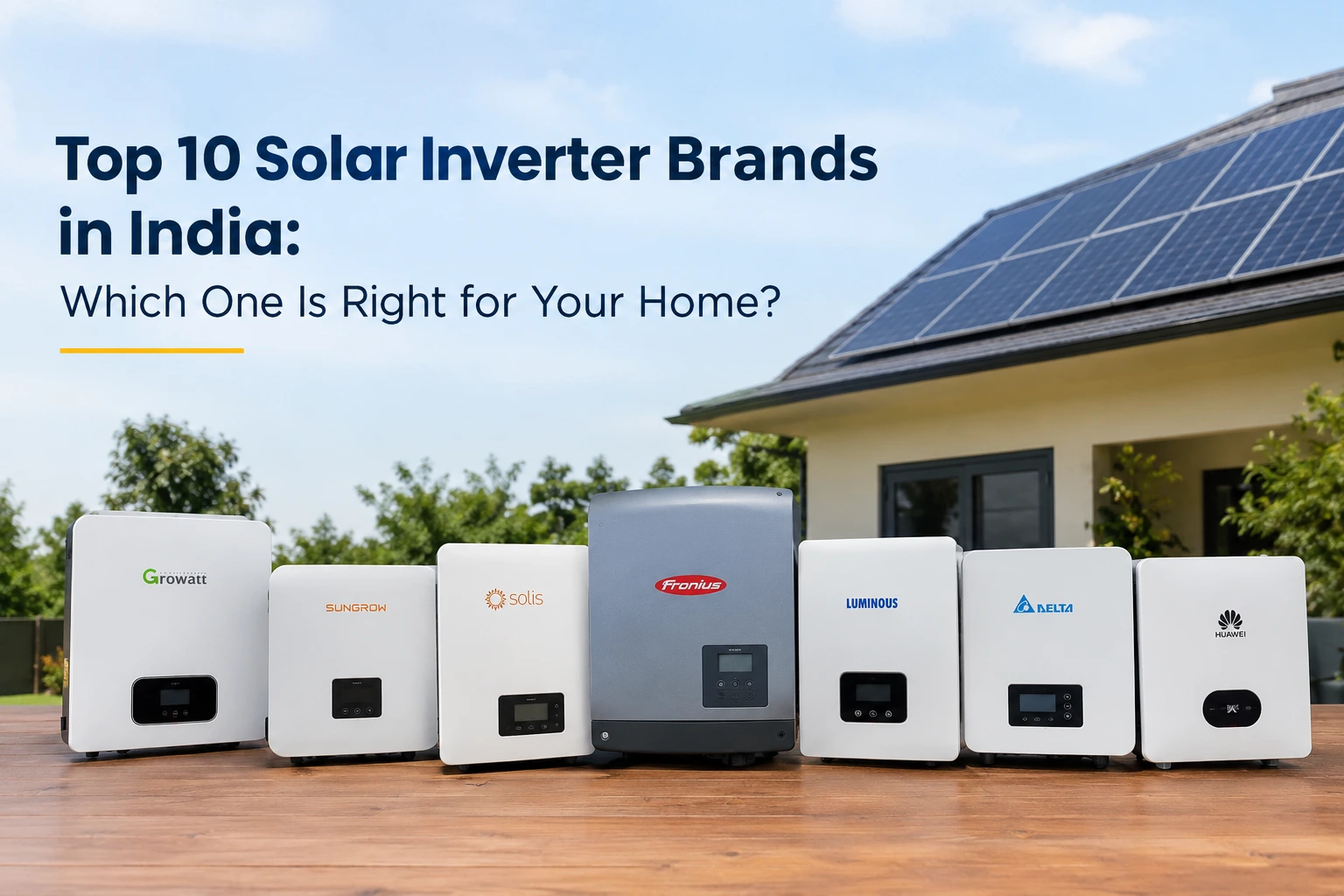
A solar inverter plays a major role in how efficiently your rooftop solar system converts sunlight into usable electricity. From lowering monthly electricity bills to providing backup during power cuts, the right inverter depends on your home’s energy consumption, roof conditions, and budget. With several brands offering different technologies and features, comparing them can help you avoid unnecessary costs and get better value from your solar investment. In this guide, we explore the top 10 solar inverter brands in India for 2027, to help you find a suitable option for your home.
Top 10 Solar Inverter Brands in India
The following brands offer different inverter technologies and features. The best option depends on your system size, budget, available roof space, and whether you need battery backup. This is a practical comparison, not a definitive ranking of product quality.
| Brand | Best suited for | What to consider |
| Eastman | Residential solar and backup options | Confirm the exact inverter type and battery compatibility |
| SolarEdge | Rooftops needing panel-level optimisation | Check optimiser compatibility and overall system cost |
| Sungrow | Residential and larger solar systems | Verify the local model and support |
| Growatt | Residential solar and selected hybrid systems | Check the model’s battery support |
| GoodWe | On-grid and storage-ready options | Compare grid-tied and hybrid models separately |
| Solis | Residential and commercial rooftop solar | Check capacity, MPPT inputs and service availability |
| Deye | Homes considering battery backup | Confirm compatible batteries and operating modes |
| Havells | Homeowners comparing established electrical brands | Request the current residential solar inverter range |
| Enphase | Roofs with multiple orientations or partial shading | Compare panel-level equipment and installation costs |
| UTL Solar | Residential solar and backup applications | Distinguish on-grid inverters from solar PCUs |
1. Eastman: A practical option for Indian homes
Eastman offers solar and power-backup products for residential applications. It is worth comparing if you want a solar solution that fits your household’s power requirements and budget.
Before choosing a model, check whether it is designed for on-grid operation, off-grid use, or hybrid backup. These systems work differently, and not every inverter supports exporting electricity to the grid.
Best for: Homeowners comparing residential solar and backup solutions.
2. SolarEdge: Advanced panel-level optimisation
SolarEdge uses inverter technology alongside power optimisers that help manage solar panel performance individually. This approach can be useful for rooftops where panels face different directions or experience partial shading.
However, the system requires compatible components, and optimisers can increase the upfront cost. A professional assessment can help determine whether this technology offers a meaningful benefit for your roof.
Best for: Homes where roof layout and shading make panel-level optimisation worth considering.
3. Sungrow: Residential and larger solar systems
Sungrow offers solar inverter solutions for residential, commercial, and utility-scale applications. Its product portfolio includes string inverters and energy-storage solutions.
When comparing models, check the system capacity, grid compatibility, monitoring features, and warranty conditions applicable in India.
Best for: Homeowners who want to compare established solar-focused inverter options.
4. Growatt: On-grid and hybrid choices
Growatt offers residential solar and energy-storage products. Depending on the model, homeowners can consider standard grid-connected systems or solutions designed to work with batteries.
If you may add a battery later, confirm whether the selected inverter supports that upgrade. A standard on-grid model should not be assumed to provide backup during power cuts.
Best for: Homeowners comparing grid-connected solar with future storage options.
5. GoodWe: Solar and storage solutions
GoodWe offers grid-tied and hybrid inverter ranges. Its residential options make it worth considering if you want to compare conventional rooftop solar with a battery-supported system.
Compare the exact model’s rated output, MPPT configuration, operating limits, and supported battery models before making a decision.
Best for: Buyers who want to evaluate both on-grid and energy-storage options.
6. Solis: A dedicated solar inverter brand
Solis offers residential and commercial solar inverter ranges, including grid-connected products and energy-storage solutions.
For a home installation, pay attention to the number of MPPTs, the permitted solar panel input, the inverter’s AC output, and the manufacturer’s support arrangements. Multiple MPPTs may be useful when your panels occupy roof sections with different sunlight conditions.
Best for: Homeowners looking for a dedicated solar inverter for rooftop installations.
7. Deye: For homes considering battery backup
Deye offers grid-connected and hybrid inverter models. A compatible hybrid system can help homeowners use stored solar energy during outages, provided it is correctly configured with suitable batteries and backup circuits.
Check the battery chemistry supported by the exact model, its backup output, and which household loads it can operate simultaneously.
Best for: Homes where power backup is an important part of the solar plan.
8. Havells: An established electrical brand to compare
Havells is a familiar name in India’s electrical equipment market. If considering its solar offerings, ask the installer for the current model catalogue and confirm that the quoted product matches your intended residential application.
Do not assume that a brand’s reputation across electrical products automatically guarantees a particular inverter’s suitability or service coverage.
Best for: Buyers who want to compare solar equipment from an established electrical brand.
9. Enphase: Microinverters for complex rooftops
Enphase uses microinverters, which convert solar power at the individual panel level rather than relying on one central string inverter for a group of panels.
This setup may help manage differences in panel output caused by shading or roof orientation. However, it can cost more than a conventional string-inverter system, so ask for a complete system quotation before deciding.
Best for: Roofs with challenging layouts where panel-level performance management may be valuable.
10. UTL Solar: Solar and backup applications
UTL Solar offers products across solar inverter and power-conditioning categories. The right choice depends on whether you need a grid-connected system, a battery-based setup, or a solar PCU for backup.
These product categories are not interchangeable. Confirm the inverter’s operating mode, battery requirements, grid-export capability, and warranty before buying.
Best for: Homeowners comparing solar generation and backup-focused configurations.
Which Solar Inverter Is Best for Your Home?
There is no single best solar inverter for every household. Your ideal choice depends on how you use electricity and what you expect from your solar system.
| Your requirement | What to consider |
| Reduce electricity bills | On-grid inverter |
| Keep appliances running during power cuts | Hybrid inverter with compatible battery backup |
| Operate independently of the electricity grid | Off-grid inverter and battery bank |
| Roof has partial shading | SolarEdge optimisers or Enphase microinverters |
| Add battery storage in the future | Compatible hybrid or storage-ready system |
For most homes in Noida and Greater Noida with reliable grid electricity, an on-grid system is worth considering first. If outages are frequent, compare hybrid options before finalising your installation.
For a more detailed comparison, read our guide to on-grid vs. off-grid vs. hybrid solar systems.
5 Things to Check Before Buying a Solar Inverter
- Match the inverter to your system size. A 3 kW rooftop system and a 5 kW system may require different inverter capacities. Your installer should calculate the appropriate sizing using the panel specifications and electrical design.
- Check efficiency and MPPT inputs. Efficiency affects how much usable electricity your system produces. MPPT helps the inverter extract power from solar panels under changing conditions. Compare the figures on the exact model datasheets rather than relying on brand-level claims.
- Read the warranty carefully. Check the standard warranty period, coverage, exclusions, and whether an extended warranty is available. Ask who will handle repairs or replacement if the inverter fails.
- Confirm service availability. A competitively priced inverter can become inconvenient if technical support or replacement parts are difficult to access. Ask for a local service contact and the written warranty terms.
- Understand backup and subsidy requirements. A standard on-grid inverter shuts down during a grid outage for safety. Battery backup requires compatible equipment designed for that purpose. For subsidy-supported installations, confirm that the proposed system meets the applicable scheme and technical requirements.
Before deciding on your system size, read our guide to rooftop solar costs in Ghaziabad for 2 kW, 3 kW, 5 kW and 10 kW systems.
How to Choose the Right Inverter with Solar Oorja
Choosing a brand is only one part of a successful solar installation. The inverter must match your panels, roof conditions, electricity consumption, and connection requirements.
Solar Oorja provides residential solar installation in Noida and Greater Noida, including system design, inverter selection, installation, net-metering coordination, and maintenance support. The team can help you compare suitable inverter options, including Eastman and other available brands, according to your home’s requirements.
If you are planning a new rooftop installation, start with a solar site assessment before purchasing equipment.
Frequently Asked Questions
1. Which is the best solar inverter brand in India in 2027?
Ans. Eastman, SolarEdge, Sungrow, Growatt, GoodWe, Solis, Deye, Havells, Enphase, and UTL Solar are options worth comparing. The best choice depends on your system type, budget, warranty, and local service availability.
2. Which solar inverter is best for a 3 kW home system?
Ans. A suitable 3 kW inverter should match the solar array, electrical connection, and expected household consumption. Compare the exact specifications and available service support before choosing a brand.
3. Does a solar inverter work during a power cut?
Ans. A standard on-grid inverter generally shuts down during a power cut. A properly designed hybrid or off-grid system can provide backup when compatible batteries and the required backup configuration are installed.
4. Is a hybrid solar inverter better than an on-grid inverter?
Ans. Not necessarily. An on-grid inverter is often suitable when your main goal is to reduce electricity bills. A hybrid inverter is worth considering when battery backup is important, although it usually increases the initial system cost.
5. How long does a solar inverter last?
Ans. The lifespan varies by model, installation conditions, temperature, maintenance, and usage. Check the manufacturer’s warranty and ensure that the inverter is installed in a well-ventilated location according to its guidelines.
6. What should I compare before buying a solar inverter?
Ans. Compare rated capacity, conversion efficiency, MPPT inputs, warranty coverage, battery compatibility, monitoring features, applicable certifications, and local after-sales service.