
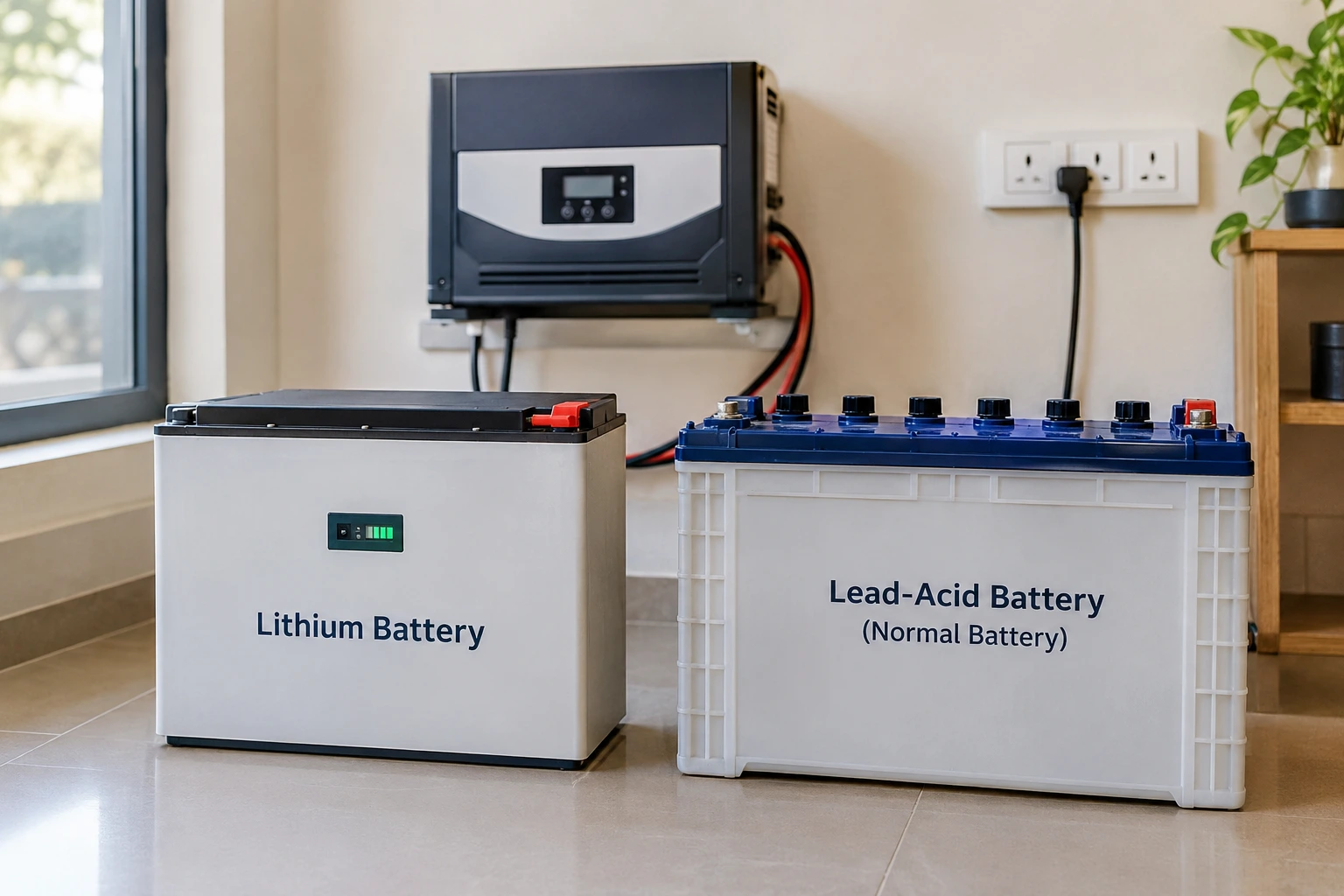
For a home inverter, choosing between a lithium battery and a normal lead-acid battery can affect your backup time, electricity costs, maintenance, and long-term savings. Both can keep essential appliances running during a power cut, but they differ in charging speed, battery life, usable capacity, and installation requirements.
The right choice depends on how often you experience power cuts, how much backup you need, and how long you plan to use the inverter. This guide compares lithium and normal batteries in simple terms so you can make a practical decision for your home.
Lithium Battery vs Normal Battery: Key Differences
When comparing lithium vs regular batteries for home inverters, a normal battery usually means a lead-acid battery, such as a flat-plate or tubular battery. A lithium battery for home backup is commonly a lithium iron phosphate (LiFePO₄ or LFP) battery.
Here is a quick comparison to help you understand the difference.
| Feature | Lithium Battery | Normal Lead-Acid Battery |
| Initial cost | Higher | Lower |
| Battery lifespan | Generally longer | Generally shorter |
| Charging speed | Usually faster | Usually slower |
| Maintenance | Usually maintenance-free | Flooded batteries need water checks |
| Usable capacity | Typically higher | Usually lower for regular use |
| Weight and size | Lighter and more compact | Heavier and bulkier |
| Deep discharge | Handles deeper discharge better | Frequent deep discharge can shorten life |
| Best suited for | Frequent power cuts and long-term use | Budget-friendly home backup |
Actual performance depends on battery quality, capacity, temperature, charging settings, and usage. Lithium batteries can cost more initially, but their longer service life and higher usable capacity may make them worthwhile over time.
1. Battery Lifespan: Which One Lasts Longer?
Battery lifespan is one of the biggest differences between lithium and normal batteries.
A good lithium iron phosphate battery can often deliver several thousand charge-discharge cycles under suitable operating conditions. A lead-acid battery generally has a shorter cycle life, particularly when it is frequently discharged deeply or not maintained properly.
For example, if your area experiences daily power cuts, your inverter battery may go through frequent charging and discharging. A lithium battery can be a practical choice because it is designed for repeated cycling.
However, lifespan is not determined by battery type alone. Charging voltage, operating temperature, discharge depth, and product quality also matter.
Which is better? Lithium is generally the better option if you want a battery that lasts longer and can handle frequent use.
2. Charging Time and Power Backup
A battery’s charging time depends on its capacity, charging current, inverter settings, and how much energy it needs to recover.
Lithium batteries generally accept charge more efficiently and can recharge faster when paired with compatible charging equipment. Lead-acid batteries usually need more time to recharge fully.
Consider a home where the electricity supply returns for only a few hours between power cuts. A compatible lithium battery may recover more charge during that period, helping you prepare for the next outage.
Remember that a larger battery is not automatically better. The battery capacity should match your electricity usage and the amount of backup you need.
For a solar-powered home, read our guide on how many solar panels you need to run an AC to understand how appliance demand affects solar system sizing.
3. Maintenance: Do Lithium Batteries Need Less Care?
Maintenance is another important factor when comparing lithium battery vs regular battery options.
Flooded lead-acid batteries need periodic checks of their electrolyte water levels, along with proper ventilation and terminal cleaning. If maintenance is ignored, their performance and lifespan may suffer.
Lithium batteries generally do not require water refilling. They usually include a battery management system (BMS) that monitors factors such as voltage, temperature, and charging conditions.
This makes lithium a convenient choice for homeowners who prefer less routine maintenance.
However, maintenance-free does not mean risk-free. Both battery types require correct installation, suitable charging equipment, and periodic inspection according to the manufacturer’s instructions.
4. Which Battery Provides More Usable Backup?
The amount of backup you get depends on the energy your battery can safely deliver, not just its advertised capacity.
Lead-acid batteries are commonly used with a conservative discharge limit to help extend their lifespan. Lithium batteries, especially LFP models, can generally provide a larger share of their rated capacity without the same impact on cycle life.
For example, consider two batteries with a nominal capacity of 1.2 kWh each.
- A lead-acid battery used to a 50% discharge level provides approximately 0.6 kWh before inverter losses.
- A lithium battery used to an 80% discharge level provides approximately 0.96 kWh before inverter losses.
These are illustrative figures, not guaranteed results. Actual usable energy depends on the manufacturer’s specifications, battery condition, inverter efficiency, and operating load.
This difference matters if you need to run lights, fans, Wi-Fi, and other essential appliances for several hours during a power cut.
Which is better? Lithium usually offers more usable energy from the same nominal capacity.
5. Lithium Battery vs Normal Battery: Which Is More Affordable?
A normal lead-acid battery is usually cheaper to purchase, making it attractive to homeowners with a limited budget.
Lithium batteries have a higher upfront cost, but the comparison should not end at the purchase price. You should also consider how long each battery may last, its usable capacity, maintenance requirements, and the cost of future replacements.
For a fair comparison, calculate:
- Initial battery and installation cost.
- Expected service life under your usage conditions.
- Cost of replacement batteries.
- Maintenance and any compatible inverter or charger upgrades.
- Usable energy available during each outage.
A lithium battery may offer better long-term value for a household that experiences frequent power cuts. A lead-acid battery may remain the more practical choice if the budget is tight and backup requirements are modest.
If you are planning to combine battery backup with rooftop solar, explore residential solar installation by Solar Oorja to understand how your home’s energy needs can influence system planning.
6. Are Lithium Batteries Safer Than Normal Batteries?
Both battery types can be used safely when installed and operated correctly, but their risks are different.
Lead-acid batteries contain lead and sulphuric acid. Flooded models may release gases while charging, so appropriate ventilation and careful handling are important.
Lithium batteries do not contain lead-acid electrolyte, but they can overheat if damaged, incorrectly charged, or exposed to unsuitable operating conditions. A quality lithium battery should include a suitable BMS and manufacturer-approved safety protections.
For home use, choose a battery from a reliable manufacturer, follow the installation instructions, and avoid unverified products. The lithium battery’s chemistry, certification, protection system, and installation quality all matter.
7. Can You Replace a Normal Inverter Battery With a Lithium Battery?
Yes, in some cases, but not every standard inverter is compatible with every lithium battery.
Before replacing a lead-acid battery with a lithium model, check the following:
- Voltage: The battery voltage must match the inverter’s requirements.
- Charging settings: The inverter must support the lithium battery’s charging profile.
- BMS communication: Some batteries require communication between the battery and inverter.
- Discharge limits: The inverter must work within the battery’s permitted operating range.
- Warranty: Confirm that the combination is approved by both manufacturers.
Do not assume that a battery will work simply because its voltage appears similar. Incorrect charging settings can cause poor performance, shutdowns, or damage.
If you are considering solar and battery backup together, explore on-grid, off-grid, and hybrid solar solutions before selecting your equipment. A hybrid system may be appropriate when you need solar generation as well as backup during power cuts.
8. Which Battery Is Better for Your Home?
The better option depends on your electricity usage, budget, and backup requirements.
Choose a lithium battery if:
- Your home experiences frequent power cuts.
- You want faster charging and more usable capacity.
- You prefer minimal routine maintenance.
- You plan to use the battery regularly for several years.
- You want a compact battery for your available installation space.
Choose a normal lead-acid battery if:
- You want a lower initial purchase cost.
- Your power cuts are occasional or relatively short.
- Your existing inverter is designed for lead-acid batteries.
- You are comfortable with the maintenance required by your battery model.
If you are planning a new solar installation, remember that a standard on-grid solar system generally shuts down during a grid outage. Battery backup requires a suitably designed hybrid or off-grid setup. You can learn more about this in our guide to off-grid solar installation.
Final Verdict: Lithium Battery or Normal Battery?
For most homeowners who prioritise long-term performance, faster charging, higher usable capacity, and less maintenance, a compatible lithium battery is worth considering. A normal lead-acid battery remains a sensible option for households looking for affordable backup with modest power requirements.
Before buying either battery, calculate your required backup time, check the inverter’s compatibility, and compare the total cost over its expected lifespan rather than looking only at the purchase price.
Frequently Asked Questions
1. What is the main difference between lithium battery vs regular battery?
Ans. The main differences are battery chemistry, lifespan, charging speed, usable capacity, maintenance, and cost. Lithium batteries generally last longer and provide more usable energy, while normal lead-acid batteries usually cost less upfront.
2. Are regular batteries lithium?
Ans. No. In the home inverter context, regular batteries generally refer to lead-acid batteries. However, the term “regular battery” can also describe other battery types, depending on the device and context.
3. Are normal batteries lithium or lead-acid?
Ans. Most conventional home inverter batteries in India are lead-acid batteries, including tubular and flat-plate models. Lithium batteries use different chemistry, with lithium iron phosphate being a common option for home energy storage.
4. Is a lithium battery rechargeable?
Ans. Yes. Lithium-ion batteries designed for home inverters are rechargeable and can be charged and discharged repeatedly. However, not every battery containing lithium is rechargeable, so check the product specifications.
5. Which is better: lithium vs regular batteries for home inverters?
Ans. Lithium batteries are generally better for frequent power cuts, longer service life, faster charging, and lower maintenance. Lead-acid batteries can be a better choice when the initial budget is the main concern.
6. Can a lithium battery run a normal home inverter?
Ans. Sometimes. The inverter must support the lithium battery’s voltage and charging requirements. Check compatibility with both manufacturers before replacing your existing battery.
7. Does a lithium battery give more backup than a lead-acid battery?
Ans. It can provide more usable backup when batteries have the same rated energy capacity because lithium batteries generally support deeper discharge. Actual backup time depends on the battery, inverter losses, and appliances being used.
8. Which battery is best for a solar inverter?
Ans. A compatible lithium iron phosphate battery is a strong option for frequent cycling and long-term solar energy storage. A lead-acid battery may suit a smaller budget. The right choice depends on system design, expected usage, and manufacturer compatibility.