
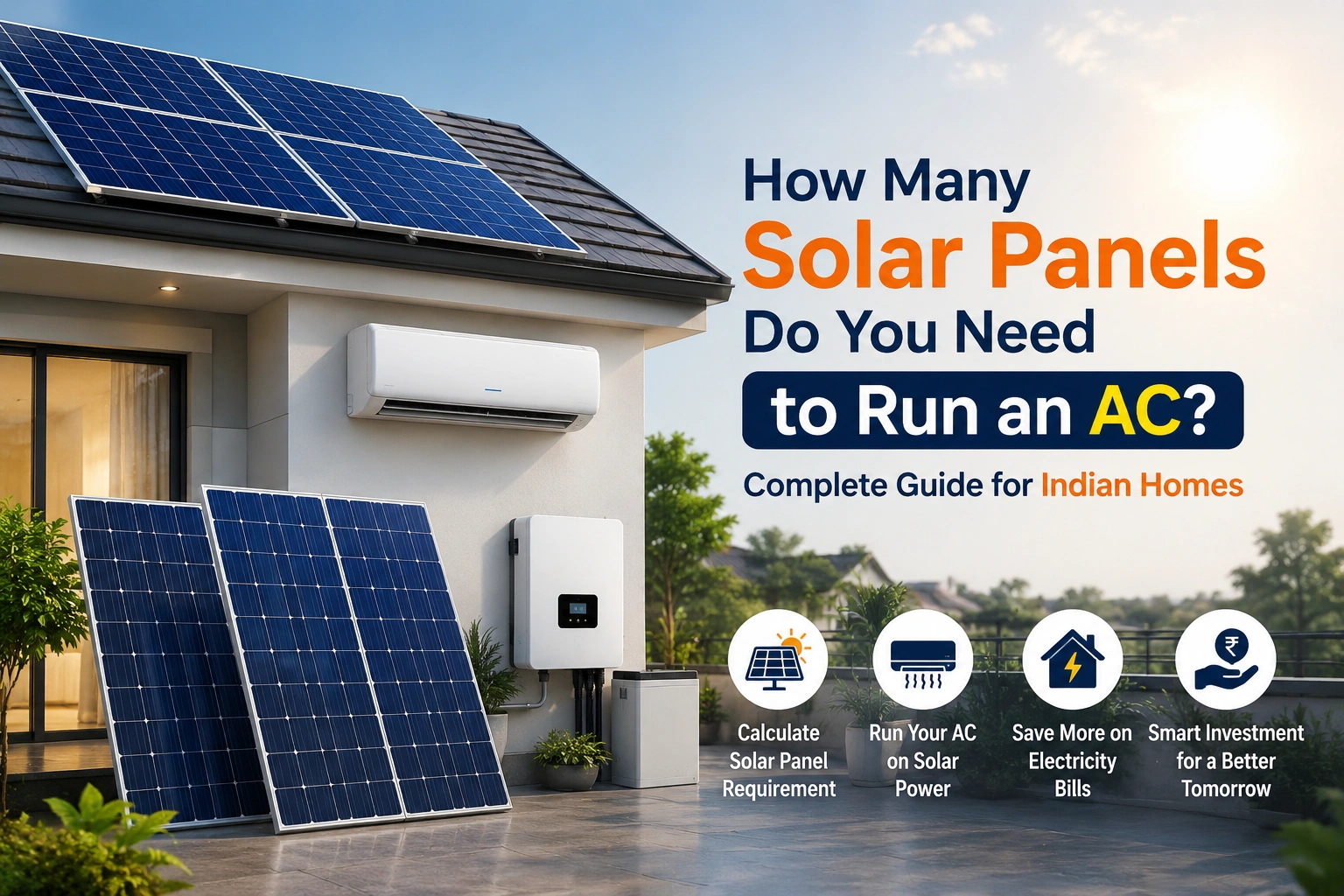
If your AC is responsible for a big chunk of your summer electricity bill, you may have already wondered:
“Can I run my AC on solar power?”
Yes, you can. But the real question is how many solar panels do you need to run an AC comfortably?
For a typical Indian home, the answer depends on your AC’s capacity, power consumption, daily usage, sunlight availability and whether you want to use the AC only during the day or at night too.
As a quick starting point, a 1.5-ton inverter AC may need roughly 4–6 solar panels of around 550W each, but this is only an estimate. The right solar system should be sized according to the AC’s actual electrical consumption and your complete household load.
Let’s make the calculation simple.
How Many Solar Panels to Run AC?
There isn’t one fixed number for every AC.
Here’s a practical estimate:
| AC Type | Approx. Solar Capacity to Consider | Approx. 550W Panels |
| 1 Ton AC | 2–4 kW | 4–7 panels |
| 1.5 Ton AC | 3–4 kW | 6–8 panels |
| 2 Ton AC | 4–5 kW | 8–10 panels |
These figures are planning estimates, not an exact system design. Actual requirements can change significantly depending on the AC model, its BEE rating, temperature, usage hours, panel generation and other appliances running at the same time.
That’s why simply buying panels based on the AC’s tonnage isn’t the best approach.
So, how many solar panels for a 1.5 ton AC?
For a modern 1.5-ton inverter AC, a 3–4 kW solar system can be a reasonable starting point for daytime operation, depending on the AC’s actual power consumption and household load.
But there’s an important catch.
Solar panels don’t continuously produce their maximum rated output. Your system needs enough capacity to handle real-world losses, changing sunlight and the AC’s varying power demand.
Why Your AC’s Tonnage Isn’t Enough
Two 1.5-ton ACs can consume different amounts of electricity.
That’s because tonnage tells you about the cooling capacity, not exactly how much electricity the AC will use.
Before deciding on solar panels, check:
- AC’s rated input power
- BEE star rating
- ISEER value
- Inverter or non-inverter technology
- Hours of daily operation
- Outdoor temperature
- Other appliances running with the AC
A more efficient AC can require less electricity for the same cooling job. BEE’s guidance also highlights the energy-saving advantage of higher-rated ACs.
So don’t let someone tell you, “You have a 1.5-ton AC, so you definitely need X panels.”
Your electricity consumption matters more than the number printed on the AC.
A Simple Example: Running a 1.5 Ton AC on Solar
Let’s say your 1.5-ton inverter AC typically draws around 1.2–1.6 kW while operating, depending on conditions.
If you run it for 6 hours, its theoretical consumption could be around:
1.4 kW × 6 hours = 8.4 kWh
But your solar panels also need to power other household appliances and account for system losses.
This is why a homeowner shouldn’t design the system around the AC alone.
A better approach is:
AC consumption + other household consumption → required solar capacity
That can prevent you from installing an undersized system that struggles during peak summer hours.
Can Solar Panels Run an AC During the Day?
Yes. This is actually the easiest way to use solar power for your AC.
During sunny hours, your solar panels generate electricity. That electricity can be used by your home appliances, including your AC.
If your solar system produces more electricity than your home needs, the surplus may be exported to the grid depending on your connection and applicable DISCOM/net-metering rules.
India’s rooftop solar programme supports grid-connected rooftop systems for residential electricity consumers, while current scheme provisions and eligibility should be checked before installation.
For homeowners who mainly use their AC in the afternoon, this can be particularly useful because solar generation and AC usage happen at roughly the same time.
But Can AC Run on Solar at Night?
Yes, but solar panels themselves don’t generate electricity at night.
If you want to run your AC after sunset using stored solar energy, you’ll need a battery-based system, typically a hybrid or off-grid setup.
Think of it this way:
Day: Solar panels → Run AC + charge battery
Night: Battery → Run AC
And here’s where things get interesting.
Running an AC from a battery for several hours can require substantial battery capacity. So if nighttime AC use is important to you, don’t size the solar system only around your panels.
You need to consider both solar generation and battery storage.
Do You Need a Solar Battery for AC?
Not necessarily.
If your main objective is to reduce electricity consumption while running your AC during the day, a grid-connected solar system may be enough.
A battery becomes more relevant when you want:
- AC backup during power cuts
- Nighttime solar-powered AC
- Greater energy independence
- Backup for essential household appliances
For many urban homes, adding a battery purely to run an AC throughout the night can make the system considerably more complex and expensive.
So before choosing one, ask yourself:
“Do I actually need AC backup at night, or do I mainly want to reduce my electricity bill?”
The answer can change your ideal solar setup completely.
On-Grid vs Hybrid Solar for Running an AC
| Feature | On-Grid Solar | Hybrid Solar |
| Runs AC during sunlight | Yes | Yes |
| Uses solar generation | Yes | Yes |
| Battery required | No | Yes |
| Nighttime backup | No | Yes |
| Power-cut backup | Usually no | Yes |
| System complexity | Lower | Higher |
For a home where the priority is lower electricity bills, on-grid solar can be a practical choice.
If backup and nighttime operation matter more, a hybrid solar system may make more sense.
Don’t Size Solar Only for Your AC
This is one of the biggest mistakes homeowners make.
Imagine you have:
- 1.5-ton AC
- Refrigerator
- Fans
- Lights
- TV
- Washing machine
- Water pump
- Other appliances
Your solar system has to work for the household, not just the AC.
And during summer, you may run the AC for longer than expected.
That’s why a proper site assessment should consider your electricity bills, connected load, appliance usage and available rooftop space before recommending a system.
Solar Oorja’s residential solar installation service covers system design and installation for homes, along with support related to net metering and applicable solar programmes.
5 Things to Check Before Installing Solar for Your AC
Before asking for a quotation, keep these five things ready:
- Your latest electricity bills
They reveal your actual household consumption better than guesswork. - Your AC’s model number
This helps determine its actual electrical specifications. - Your daily AC usage
Running an AC for 3 hours and 10 hours a day creates very different requirements. - Your rooftop space
The number of panels you can install depends partly on available shadow-free roof area. - Whether you need nighttime backup
This determines whether you should consider batteries.
The smartest next step?
Don’t start with “How many panels should I buy?”
Start with:
“How much electricity does my home actually consume, and how much of it do I want solar to cover?”
That’s how you avoid paying for an oversized system—or discovering later that your system isn’t powerful enough.
Final Takeaway
How many solar panels to run AC? For many Indian homes, the starting point may be somewhere around 4–8 panels, depending on AC size, panel wattage and household requirements.
But the better question isn’t simply the number of panels.
It’s how much of your home’s electricity you want solar to handle.
If you’re planning solar specifically to tackle those summer AC bills, get your AC details and recent electricity consumption assessed before choosing the system. A correctly sized system can help you use solar where it matters most—without spending unnecessarily on capacity you don’t need.
Solar Oorja can help you assess your residential solar requirement and determine what setup makes sense for your home.
FAQs
How many solar panels are needed to run a 1.5-ton AC?
A 1.5-ton inverter AC may typically be paired with around a 3–4 kW solar system for daytime operation, which could mean approximately 6–8 panels if using 550W modules. The exact requirement depends on the AC’s actual power consumption, usage and other household loads.
Can I run my AC directly from solar panels?
Yes, a suitably designed solar system with the appropriate inverter can supply electricity to your AC. The system should be sized for the AC and other appliances operating at the same time.
Can AC run on solar at night?
Solar panels don’t generate electricity at night. To operate an AC on stored solar energy after sunset, you need adequate battery storage through a suitable hybrid or off-grid system.
Is a battery necessary for solar AC?
No. If you’re primarily using the AC during sunny hours and have a grid connection, you may not need a battery. Batteries become important when nighttime operation or backup during power cuts is required.
Is a 3kW solar system enough to run an AC?
It may be enough for some daytime AC usage, but it shouldn’t be assumed without checking the AC’s actual consumption and the rest of the home’s load. A proper system assessment is more reliable than sizing purely by AC tonnage.
Does a 5-star AC need fewer solar panels?
A more energy-efficient AC can consume less electricity for the same cooling requirement, potentially reducing the solar capacity needed. However, the actual difference depends on the specific models and operating conditions.