
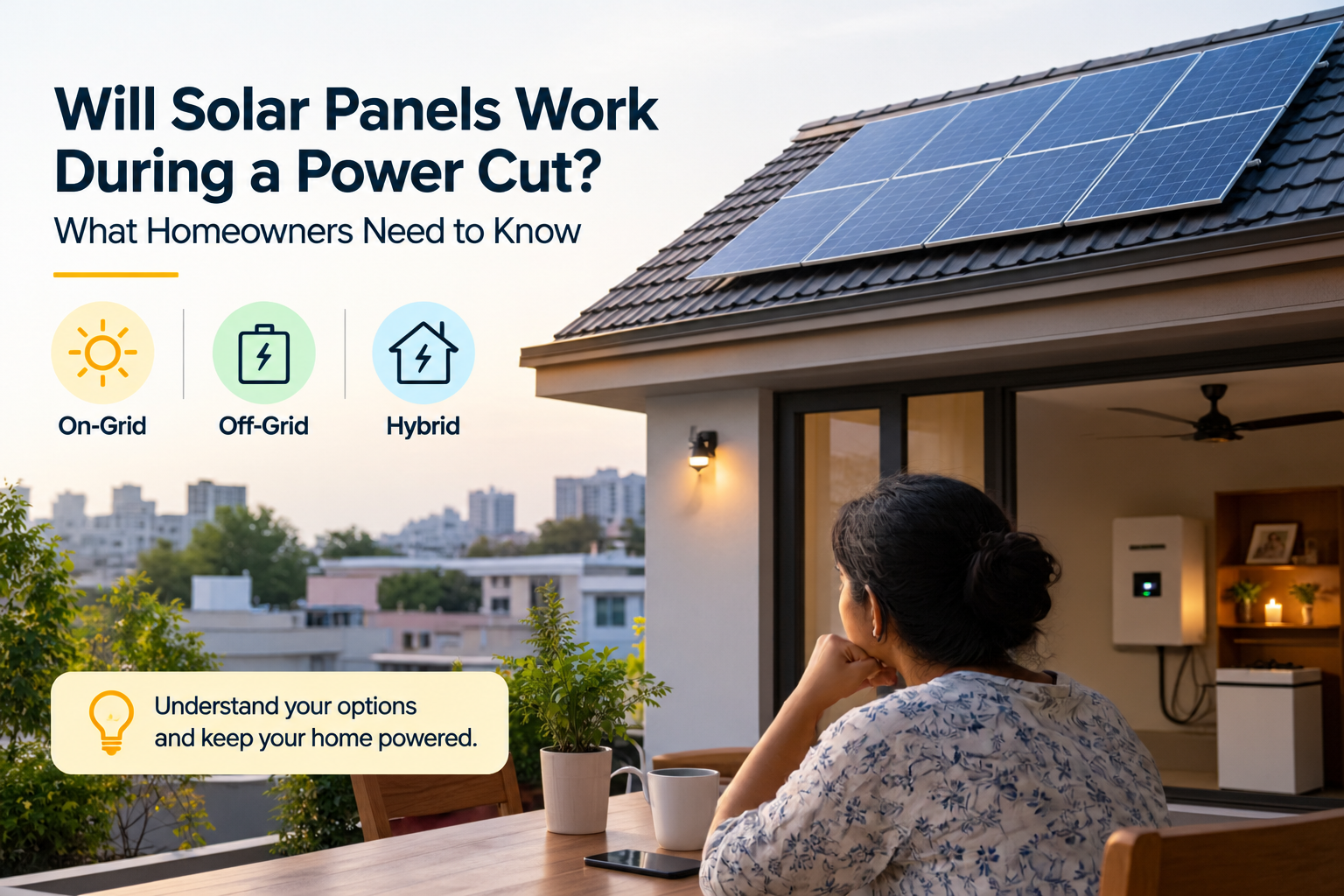
A power cut can be frustrating, especially during the hot summer months in Uttar Pradesh when fans, coolers and air conditioners are essential for daily comfort. If you have rooftop solar panels or are planning to install them, one important question comes to mind: Will solar panels keep your home running when the electricity goes out? The answer depends on your solar system. While a standard on-grid system usually stops supplying electricity during a power cut, an off-grid or properly configured hybrid system can provide backup with the right battery and inverter setup. Understanding this difference can help you choose the right solar solution for your home.
Why Do Solar Panels Stop Working During a Power Cut?
Solar panels generate electricity from sunlight, but they need the right equipment to make that electricity usable in your home.
Most grid-connected rooftop solar systems use an inverter to convert the direct current (DC) generated by panels into alternating current (AC), which household appliances use.
When the electricity grid goes down, a standard on-grid inverter automatically stops supplying power. This safety feature is called anti-islanding protection.
It prevents solar electricity from flowing into power lines that utility workers may be repairing during an outage. Without this protection, those lines could remain dangerously energised.
Therefore, even if the sun is shining and your panels could generate electricity, a standard on-grid system will not normally power your home during a blackout.
According to the Uttar Pradesh New and Renewable Energy Development Agency (UPNEDA), grid-connected solar systems disconnect during grid failure to protect people working on electrical lines.
Which Solar Systems Work During a Power Cut?
There are three main types of rooftop solar systems. Understanding their differences will help you choose the right setup for your home.
1. On-Grid Solar System
An on-grid solar system connects your rooftop panels to the electricity grid. During normal operation, solar power supplies your home, and surplus electricity may be exported to the grid under the applicable net-metering arrangement.
When solar generation is insufficient, electricity can be drawn from the grid.
However, a standard on-grid system without backup equipment stops supplying power during an electricity cut.
Best for: Homeowners who mainly want to reduce electricity bills and have a relatively reliable grid connection.
2. Off-Grid Solar System
An off-grid solar system operates independently of the electricity grid. It uses solar panels, a compatible inverter and batteries to supply electricity to connected appliances.
During the day, solar panels can power your home and charge the batteries. When sunlight is unavailable, stored energy can supply the connected loads.
This setup can be useful for homes, farmhouses or properties where grid electricity is unavailable or unreliable.
Best for: Homes that need independent electricity and do not rely on exporting surplus solar power to the grid.
3. Hybrid Solar System
A hybrid solar system combines solar panels, grid connectivity, a compatible inverter and battery storage.
During a power cut, a properly configured hybrid inverter isolates the home backup circuit from the electricity grid and supplies supported appliances using available solar energy and stored battery power.
During the day, solar generation may run connected appliances while charging the battery. At night, the battery provides backup until its usable capacity is exhausted or the grid returns.
Keep in mind that not every hybrid system automatically backs up every appliance. The inverter, battery capacity and backup circuit must be designed for your requirements.
Best for: Homeowners who want to reduce electricity bills while keeping essential appliances running during power cuts.
On-Grid vs Off-Grid vs Hybrid Solar
| Feature | On-grid | Off-grid | Hybrid |
| Connected to grid | Yes | No | Yes |
| Battery storage | Usually no | Yes | Yes |
| Works during power cuts | Normally no | Yes, with available stored energy | Yes, with suitable backup configuration |
| Main purpose | Bill savings | Independent power | Bill savings and backup |
| Initial cost | Generally lower | Depends on battery and system size | Generally higher due to backup equipment |
Can Solar Panels Run Fans, Lights, a Refrigerator or an AC During a Power Cut?
Yes, a suitable battery-backed solar system can run these appliances, but the number of appliances and the duration depend on your system’s capacity.
For example, lights, ceiling fans and a Wi-Fi router generally need less power than a refrigerator, water pump or air conditioner.
If you want backup for essential appliances, make a list of what must keep running during an outage. An installer can then calculate the required inverter output, battery capacity and expected running time.
Running an AC during a power cut is possible with a suitably sized system, but air conditioners can consume substantial energy. Their starting requirements, operating consumption and the number of hours you use them all affect battery backup.
Do not choose a system based only on the solar panel capacity in kilowatts. Solar generation capacity and battery storage capacity are different things. Both matter when planning backup.
How Long Will Solar Battery Backup Last?
Solar battery backup depends on usable battery capacity, appliance consumption, inverter efficiency and how much energy is available from the panels during the outage.
A simple estimate is:
Backup time (hours) = usable battery energy (kWh) ÷ average appliance load (kW)
For example, if a battery has 4 kWh of usable energy and your connected appliances consume an average of 0.5 kW, the estimated backup is around eight hours.
This is a simplified calculation. Actual backup may be shorter because of conversion losses, changing appliance loads and battery operating limits.
During cloudy weather or at night, the panels may not generate enough electricity to support the load, so the battery becomes particularly important.
Before installation, ask your solar provider for an estimate based on your actual appliances rather than a general promise of all-day backup.
Which Solar System Is Best for Homes in Uttar Pradesh?
For homeowners across Uttar Pradesh, the right system depends on electricity bills, outage frequency, roof space and the need for backup.
In areas such as Noida, Greater Noida and Ghaziabad, an on-grid system may suit households that primarily want to reduce electricity costs. However, if power cuts regularly interrupt work, cooling or essential appliances, a battery-backed hybrid system may be worth considering.
In locations where grid supply is unreliable or unavailable, an off-grid system may be more appropriate.
Before making a decision, consider these points:
- Check your electricity usage: Review your monthly bills and identify your daytime and nighttime consumption.
- List essential appliances: Decide whether you need backup for lights and fans only or also for a refrigerator, pump or AC.
- Estimate outage duration: A short interruption requires a different storage capacity from a prolonged outage.
- Compare the total cost: Include the inverter, batteries, installation, maintenance and potential battery replacement.
- Confirm system compatibility: Make sure the inverter supports the intended backup configuration and has suitable safety protection.
Does Rooftop Solar Still Save Money if It Does Not Work During a Power Cut?
Yes. A standard on-grid solar system can still reduce electricity bills even though it does not provide backup during a grid failure.
During normal operation, your home can use solar electricity when it is generated. Depending on the system and applicable net-metering arrangements, surplus electricity may be exported to the grid.
However, if your main priority is keeping appliances running during power cuts, you should account for the additional cost of batteries and compatible backup equipment.
Also, do not assume that every solar system qualifies for the same subsidy. Check the current eligibility requirements under the applicable government scheme before installation.
Final Thoughts
Solar panels can help homeowners reduce electricity bills, but they do not automatically provide backup during a power cut. A standard on-grid system usually shuts down when the grid fails, while an appropriately designed off-grid or hybrid system can supply electricity through batteries and compatible equipment.
For homes in Uttar Pradesh, the best choice depends on whether your priority is lower electricity bills, reliable backup or a combination of both.
Before investing, discuss your power requirements, battery capacity and essential appliances with a qualified installer. Choosing the right configuration from the beginning can help you get more value from your rooftop solar system.
Frequently Asked Questions
1. Will solar panels work during a power cut in Uttar Pradesh?
Yes, if you have a properly configured off-grid or hybrid solar system with suitable battery storage. A standard on-grid system normally shuts down during a grid failure.
2. Why does my on-grid solar system stop working when electricity goes out?
It uses anti-islanding protection, which disconnects the system from the grid during an outage to protect utility workers and prevent unsafe electricity flow into power lines.
3. Can solar panels charge a battery during a power cut?
Yes, if the system has a compatible inverter and backup configuration that allows solar charging during an outage. Actual charging depends on sunlight, battery condition and available solar generation.
4. Can I run a fan and refrigerator on solar battery backup?
Yes, provided the inverter can handle their power requirements and the battery has sufficient usable capacity. A refrigerator’s compressor starting load should also be considered.
5. Can I run an AC during a power cut with solar panels?
Yes, with a suitably sized hybrid or off-grid system. The inverter must handle the AC’s electrical requirements, and the battery must store enough energy for the intended operating time.
6. Can I add a battery to my existing on-grid solar system?
Possibly. It depends on your existing inverter, its battery compatibility and whether a suitable backup arrangement can be installed. A qualified installer should inspect the system before recommending an upgrade.
7. Does an on-grid solar system need a battery?
No. A standard on-grid system can operate without batteries and is generally used to reduce electricity bills. However, it normally cannot provide backup during a power cut.
8. Which solar system is best for frequent power cuts?
A hybrid system with compatible battery storage is a practical option for homes that want both grid connectivity and backup. An off-grid system may suit properties with very limited or no grid access.