
For factories, offices, warehouses and hospitals, electricity is a monthly bill that rarely gets smaller, and rooftop solar can cut it significantly. Still, a vendor quote promising “free power for 25 years” is not an investment decision. To work out solar ROI for a commercial building, first estimate annual savings by multiplying the units your system will generate by the tariff you would otherwise pay. Subtract annual operating costs, divide the result by the total installed cost, and multiply by 100 to get your ROI.
Then divide the total installed cost by your net annual savings to find the payback period. For businesses in Noida, Greater Noida and Ghaziabad, these numbers depend less on how many panels you install and more on local factors: your discom’s tariff (PVVNL or NPCL), how much of your load runs during daylight hours, the cost per kW, and Uttar Pradesh’s rules for exporting surplus power to the grid.
What Is Solar ROI and Why Does It Matter?
Solar return on investment (ROI) measures the financial return from the money invested in a solar power system.
A commercial solar assessment should consider three important measures:
- Annual net savings: The estimated yearly financial benefit after operating expenses.
- Payback period: The time required for cumulative savings to recover the initial investment.
- ROI percentage: The annual net savings expressed as a percentage of the initial investment.
A system with higher generation does not automatically deliver better returns. The value of that electricity depends on how much your business consumes, the tariff it would otherwise pay and the compensation available for surplus electricity.
What Information Do You Need Before Calculating Solar ROI?
Collect the following information before estimating your commercial solar investment.
| Information | Why it matters |
| Electricity bills for 12 months | Shows consumption patterns, tariffs and seasonal changes |
| Proposed system capacity | Determines the potential electricity generation |
| Expected annual generation | Estimates how many units the system may produce |
| Total installed cost | Includes equipment, installation, electrical work and other project costs |
| Daytime electricity consumption | Helps estimate how much solar electricity the building can use directly |
| Export or net-metering terms | Determines how surplus generation is valued |
| Annual maintenance costs | Accounts for cleaning, inspections, repairs and other operating expenses |
Also review your sanctioned load, roof condition, shading, electrical infrastructure and applicable DISCOM requirements before finalising the system size.
How to Calculate Solar ROI for a Commercial Building
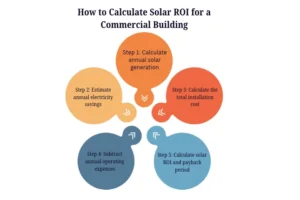
Step 1: Calculate annual solar generation
Solar generation depends on system capacity, sunlight, orientation, shading, equipment efficiency and weather conditions.
Use the following formula:
Annual solar generation = Installed capacity × Annual generation per kW
For example, if a proposed 50 kW system is expected to generate 1,500 units per kW annually:
50 kW × 1,500 units = 75,000 units per year
This is an illustrative assumption, not a generation guarantee. Ask your installer for a site-specific estimate based on local solar conditions and the proposed design.
Step 2: Estimate annual electricity savings
Not every unit generated by your solar system will necessarily have the same financial value.
Electricity consumed directly by your business can offset purchases from the grid. Surplus electricity may receive credits or compensation according to the applicable metering arrangement and regulations.
Use this formula:
Annual electricity value = Self-consumed solar units × Avoided electricity tariff + Exported solar units × Applicable export value
Suppose the 50 kW system generates 75,000 units annually. Your business uses 85% of this electricity directly, while the remaining 15% is exported.
- Self-consumed electricity: 63,750 units
- Exported electricity: 11,250 units
- Assumed avoided electricity tariff: ₹8 per unit
- Assumed export value: ₹2 per unit
The estimated annual electricity value would be:
63,750 × ₹8 + 11,250 × ₹2 = ₹5,32,500
These tariff and export values are hypothetical. Actual savings depend on your electricity bill, tariff category and approved metering arrangement.
Step 3: Calculate the total installation cost
The total project cost should include more than the solar panels.
Account for:
- Solar modules and inverters
- Mounting structures and installation
- Cabling, protection equipment and earthing
- Metering, approvals and electrical integration
- Necessary roof repairs or structural work
- Monitoring equipment and other project-specific expenses
For this example, assume the complete 50 kW installation costs ₹25 lakh Approx.
Use the final written quotation rather than a generic online price. Compare proposals on the same basis, including GST treatment, warranties, maintenance coverage and exclusions.
Step 4: Subtract annual operating expenses
Solar systems require maintenance even after installation. Your financial model should account for panel cleaning, inspections, monitoring, repairs and any applicable insurance or service charges.
Suppose annual operating expenses are estimated at ₹50,000.
Annual net savings = Annual electricity value − Annual operating expenses
₹5,32,500 − ₹50,000 = ₹4,82,500 per year
This estimate excludes financing costs, tax effects and future changes in tariffs or generation.
Step 5: Calculate solar ROI and payback period
Once you know the initial cost and annual net savings, calculate the simple annual ROI:
Annual ROI = (Annual net savings ÷ Initial investment) × 100
Using the example:
(₹4,82,500 ÷ ₹25,00,000) × 100 = 19.3% annual simple ROI
Now calculate the simple payback period:
Payback period = Initial investment ÷ Annual net savings
₹25,00,000 ÷ ₹4,82,500 = approximately 5.2 years
This means the system could recover its initial investment in about 5.2 years if the assumed annual net savings remain constant. It is a simplified estimate, not a guaranteed return.
Example: Calculating ROI for a 50 kW Commercial Solar System
Here is a summary of the hypothetical project.
| Parameter | Estimated value |
| Installed capacity | 50 kW |
| Annual solar generation | 75,000 units |
| Annual electricity value | ₹5,32,500 |
| Annual operating expenses | ₹50,000 |
| Annual net savings | ₹4,82,500 |
| Initial investment | ₹25,00,000 |
| Simple annual ROI | 19.3% |
| Simple payback period | 5.2 years |
The example shows why businesses should calculate ROI using their actual electricity consumption and tariffs. Two buildings with the same solar capacity can achieve different financial results because their energy usage, installation costs and export arrangements differ.
What Factors Affect Commercial Solar ROI in Uttar Pradesh?
1. Electricity tariff and consumption patterns
Businesses that use substantial electricity during daylight hours may be able to consume more solar generation directly. This can improve the value of each unit generated.
Review energy charges separately from fixed and demand-related charges. Solar generation does not automatically eliminate every component of an electricity bill.
2. Net metering and surplus electricity
UPNEDA explains that grid-connected rooftop solar can supply a building’s daytime demand and export surplus power to the grid. The financial value of that surplus depends on the applicable rules and metering arrangement.
Before finalising your ROI calculation, confirm the current requirements with the relevant distribution company, such as NPCL or UPPCL, as applicable to your premises.
3. System cost and maintenance
A lower installation price may not represent the best long-term investment if it involves unsuitable equipment, poor workmanship or limited maintenance support. Compare total project costs, expected generation, warranties and ongoing service requirements.
4. Financing and tax treatment
A cash purchase, business loan and third-party power purchase agreement can produce different cash flows. Eligible businesses may also need to assess applicable tax depreciation and GST treatment with their accountant. Do not assume a tax benefit or residential subsidy applies automatically to a commercial project.
How Can Businesses Improve Solar ROI?
Before approving a project, consider these practical steps:
- Review 12 months of electricity bills. Identify seasonal changes and daytime consumption.
- Match system capacity to your actual load. Avoid sizing a system around roof space alone.
- Request a generation estimate. Ask for the assumptions behind expected annual output.
- Compare installation proposals. Review equipment, warranties, maintenance and project exclusions.
- Check export rules before installation. Do not value surplus electricity at the full retail tariff without confirming eligibility.
- Monitor performance after commissioning. Compare actual generation with expected output and investigate persistent shortfalls.
For businesses planning commercial solar installation in Noida, Greater Noida or Ghaziabad, a site assessment can help establish a realistic system size, installation cost and savings forecast.
Conclusion
Calculating solar ROI for a commercial building starts with realistic estimates of generation and electricity savings. Once you account for installation costs, maintenance and applicable grid-export terms, you can estimate the annual return and payback period more confidently.
For a business in Noida, Greater Noida, or Ghaziabad, the next step is to assess the site and electricity bills before deciding whether to invest. A project-specific financial model is more useful than relying on generic solar savings claims.
Frequently Asked Questions
1. How do I calculate solar ROI for a commercial building?
Estimate annual electricity savings, subtract annual operating expenses, divide the result by the initial investment and multiply by 100 to calculate simple annual ROI.
2. What is the difference between solar ROI and payback period?
ROI expresses the financial return as a percentage of the investment. The payback period estimates how long cumulative savings take to recover the initial cost.
3. How long does commercial rooftop solar take to pay for itself?
It depends on installation cost, electricity tariffs, solar generation, self-consumption, operating expenses and financing. Calculate the payback using project-specific figures rather than relying on a universal timeframe.
4. Does a commercial solar system eliminate the entire electricity bill?
Not necessarily. Businesses may still pay fixed charges, demand charges and charges for electricity imported from the grid. The outcome depends on the tariff structure and system configuration.
5. Is commercial solar eligible for government subsidies in India?
Do not assume that residential rooftop solar subsidies apply to commercial properties. Eligibility depends on the scheme, consumer category and applicable conditions. Verify the current rules before including any incentive in your financial model.