
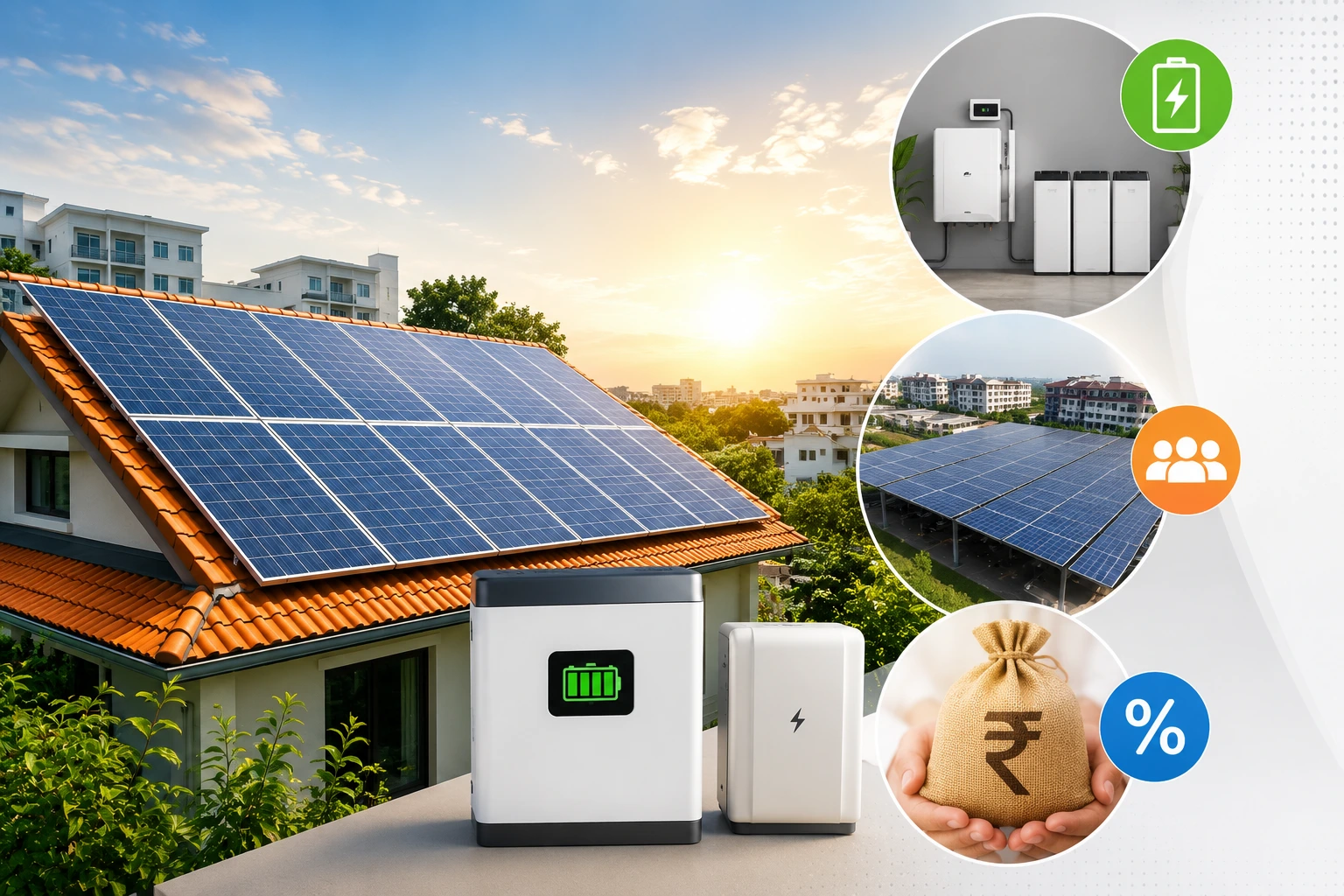
PM Surya Ghar Yojana has already made rooftop solar more affordable for homeowners across India. Now, with growing discussions around PM Surya Ghar 2.0, many people are wondering whether they should install solar now or wait for the next phase. This guide explains what’s officially announced, what’s still under discussion, and what these updates could mean for your solar investment.
What is PM Surya Ghar Muft Bijli Yojana
PM Surya Ghar Muft Bijli Yojana is the central government’s rooftop solar scheme for homes. Prime Minister Modi launched it on February 13, 2024. The Ministry of New and Renewable Energy (MNRE) runs it, and the budget is ₹75,021 crore.
The idea behind it is simple. The government pays a part of your solar installation cost. You put panels on your roof. Your electricity bill drops to almost nothing.
Three things you get:
- Money in your bank account: Up to ₹78,000 from the centre, paid directly to you after installation. Not a loan. Not a discount coupon. Actual cash transfer.
- Up to 300 free units a month: Your panels make power during the day. Whatever you do not use goes to the grid, and you get credit for it. For most homes with a 3 kW system, that covers the monthly bill entirely.
- A system that lasts 25 years: Panels carry a 25-year warranty. Once the system pays for itself in two to four years, the power after that is basically free.
The target is one crore homes by FY 2026-27. As of late 2025, around 24 lakh households were done, with over 53 lakh applications filed. So the scheme is moving, but the queue is long, and the money is not unlimited.
That is the scheme running today. Now to the part everyone is asking about.
What is PM Surya Ghar 2.0?
Here is the honest answer, and it matters.
PM Surya Ghar 2.0 is not an announced scheme. There is no notification, no scheme document, no launch date. What exists is a set of changes reportedly being discussed inside MNRE (Ministry of New and Renewable Energy). You can check the official scheme guidelines page yourself. Every notification MNRE has issued for this scheme is listed there, and none of them mention 2.0.
Four ideas keep coming up in the report:
- Paying subsidy based on how much power your system actually makes, instead of only its size.
- Bringing battery storage into the subsidy.
- Opening the scheme to people who do not have their own rooftop.
- Creating a digital record for every installed system.
Good ideas, all of them. But right now they are proposals, not rules. Anyone telling you “2.0 is launching next month with battery subsidy” is guessing.
So the scheme you can apply for today is still the original PM Surya Ghar Muft Bijli Yojana, with the same slabs and the same process.
PM Surya Ghar Subsidy: What You Actually Get in 2026
| System size | Central subsidy |
| 1 kW | ₹30,000 |
| 2 kW | ₹60,000 |
| 3 kW and above | ₹78,000 |
The maths behind PM Surya Ghar subsidy: ₹30,000 per kW for the first two kilowatts, then ₹18,000 for the third. After 3 kW, it stops. Install 5 kW or 10 kW and your central subsidy is still ₹78,000.
In Uttar Pradesh, there is a state top-up as well, which pushes total support for a 3 kW system to around ₹1,08,000. This is why a 3 kW plant in Noida or Ghaziabad usually costs ₹60,000 to ₹80,000 out of pocket. The full breakdown is on our subsidy page.
One important point. The Subsidy is a Direct Benefit Transfer. It comes to your bank account after installation and inspection. It does not go to the vendor, and no vendor should be adjusting it in your quote.
PM Surya Ghar Eligibility: Do You Qualify?
The rules for PM Surya Ghar eligibility are short.
- Indian citizen with a residential electricity connection.
- You own the property, or you have written permission from the owner.
- Your roof gets good sunlight for most of the day.
- No rooftop solar subsidy claimed earlier on that same connection.
- Grid-connected system, installed by an MNRE-empanelled vendor listed on the portal.
Two mistakes cost people real money.
The first is thinking subsidy is per person. It is per residential electricity connection. One bill, one claim.
The second is bigger. If you install first and apply later, you lose the subsidy completely.
The application has to be approved before the panels go up. We have seen families in Greater Noida lose ₹78,000 because a local vendor installed first and promised to “adjust the paperwork later”. That paperwork cannot be adjusted.
Housing societies and RWAs can apply too, but for common-area load at a separate rate.
PM Surya Ghar Yojana registration: step by step
Registration happens on the national portal pmsuryaghar.gov.in. Six stages:
- Register with your state, DISCOM, and consumer number from your electricity bill.
- Apply for feasibility approval from your DISCOM (NPCL or PVVNL in our area).
- Once approved, choose an empanelled vendor and get the system installed.
- Apply for net metering.
- The DISCOM installs the bidirectional meter and issues a commissioning certificate.
- Submit your bank details on the portal; the subsidy will be credited.
Most applications get stuck at stage two or stage five. Usually the reason is small: the name on the electricity bill does not match the name on the bank account or Aadhaar. Sort that out before you start, and you save yourself weeks.
Done properly, the full journey takes six to ten weeks. If you would rather not deal with the portal at all, we handle the entire filing for our customers.
What PM Surya Ghar 2.0 could change
This might be one of the most interesting parts. If these proposals go through, here is what shifts.
Subsidy linked to generation, not just size
Today the government pays you for what you install. The proposal is to link support to how much power your system actually produces over the years.
This one makes sense. Plenty of subsidised systems across India were installed, paid for, and then never cleaned again. Output drops 20 to 30 percent, and nobody notices. A generation-linked model rewards the homeowner who looks after the system, and quietly punishes the vendor who vanished after commissioning.
If it happens, panel quality and service support stop being optional extras.
Battery Storage Support
You can add a battery to your solar system today. Nobody stops you. But the subsidy is calculated only on solar capacity up to 3 kW, so the battery cost is fully yours, usually ₹70,000 to ₹1,20,000 for a useful 5 to 10 kWh unit.
Under 2.0, storage may be included in the subsidy at both the home and community levels.
For anyone dealing with regular evening power cuts, that would change everything. A normal on-grid solar system gives you nothing at 8 pm during an outage, because it shuts off when the grid goes down. A battery is what fixes that.
If you want backup power right now, you need a hybrid solar system, and the battery is your cost.
Shared rooftop solar for flats
This is the biggest hole in the current scheme.
Live in a flat in Noida Extension or Indirapuram? You do not have your own rooftop. So the scheme has almost nothing for you as an individual.
The reported fix uses shared community solar plants, balcony solar units, and virtual net metering. In simple terms: a solar plant sits somewhere else, and the units it makes get credited to your personal electricity bill. Owning a roof would stop being the entry ticket.
Some groundwork is already there. RESCO and utility-led models exist under the current scheme, and societies can already do common-area solar today.
Digital solar passport
A proposed digital record for every system, tracking generation, service history and warranty status in one place.
Sounds boring, but it is useful. It helps when you sell the house, when you fight a warranty claim, and when your original installer stops picking up the phone.
Why Choose Solar Oorja for Your Solar Installation
We are MNRE-empanelled, UPNEDA-registered and listed on the PM Surya Ghar portal, working across Noida, Greater Noida and Ghaziabad.
We file your registration, follow up on DISCOM feasibility, handle net metering with NPCL or PVVNL, and chase the subsidy until it lands in your account. You sign where we point.
And when MNRE actually announces something on 2.0, we will tell you what it means for your system.
Want to see what your roof can do? Try our solar calculator, or call +91 92177 20915 for a free site survey.
FAQs
Is PM Surya Ghar 2.0 officially launched?
No. It is a set of proposals reportedly under discussion at MNRE. No notification has been issued, and no launch date exists.
Will I get a subsidy on a battery?
Not today. The current subsidy covers solar capacity up to 3 kW only. Battery support is part of the 2.0 discussion but has not been confirmed.
Can flat owners apply right now?
Not as individuals, unless you have exclusive rights to a roof area. Housing societies can apply for common-area systems. Shared models for individual flats are part of the 2.0 proposals.
Does a bigger system mean a bigger subsidy?
No. The central subsidy stops at ₹78,000 for 3 kW. A 5 kW or 10 kW system still makes sense if your usage is high, but the subsidy amount does not increase.
I already installed solar without applying. Can I still claim?
No. The application has to be approved before installation. This is the most expensive mistake people make.
How long does the whole process take?
Six to ten weeks from registration to subsidy credit, if the documents are clean. Installation itself takes one to three days.